Author: Alex Yew

  • The Scholarship Application Process

    The Scholarship Application Process

    If you have decided that you would like to apply for a scholarship then you will need to start by finding one. You will also need to apply early because you do not want to be rushed and pressured to get your application in on time. If you have really good grades and you have been able to maintain them for most of your academic career, look for academic scholarships. If you are really good in sports, then this is where you may want to focus your attention and you will want to conduct a search for these types of scholarships. Just take your time. You will find a large list of different scholarships online, at your local library or even from your school counselor.

    Take some time and really think about your positive qualities. What are you good at? What do people like about you? Do you have any experience or hobbies that make you special or help you stand out from others? What makes you the best person for the scholarship that you are looking at? If you are able to write these things down, you will be more prepared for the entire process when you are ready to start applying and completing applications. It is always best to brainstorm because you will not feel stuck the further along you get.

    Once you have your list of available scholarships you will need to get ready to apply. You should never start this process without taking your time and reading through all of the qualifications and directions very carefully. You may also find a large amount of small print on the pages and you must be sure that you are reading that as well.

    Something that you should look for when it comes to reading the application is to search for anything that says if you will be given special consideration for any work that you have completed in the past. For example, if you volunteered you may be able to write an essay about that and it can greatly improve your chances of getting the scholarship over those individuals that did not volunteer.

    Many of the scholarships that you find are going to require you to apply in the form of an essay. Always have someone read through what you have prepared to ensure that the questions were answered completely and that your spelling and grammar is correct. You will make a very poor impression if you do not do this and your essays are incomplete.

    As you can see, it can be very easy to apply for scholarships as long as you are taking your time. You may be a little bit concerned about this in the beginning but the more scholarships that you apply for the more you will be learning. It becomes easier the more that you do it and you will find that you will be more relaxed as time goes by.

    You never want to let your nerves get the better of you and you shouldn’t give up just because you are unsure about something. What you need to remember is that in many cases you may never meet the individuals that are giving you the scholarship. So, you should just try to relax and put in your best effort. If you do not succeed then no one needs to know. You can just apply for the next one and try even harder. Always try to find out why you did not get the scholarship because this can really help you determine what you may be able to do differently on the next one that you apply for. You can learn from your mistakes and that can really help you in the future if you are willing to turn a negative into a positive when it comes to your college career and your life goals.


  • Cash Advance Loans and Students – A Dangerous Mix

    Cash Advance Loans and Students – A Dangerous Mix

    Are you a college student wondering how online cash advance/payday loans fit into your finances? If you are a smart college student, then you will know online payday loans are only for emergencies. The payoff comes in just a few short weeks, so steady income is a must in order to pay it off without putting more damage into your finances.

    Here are five tips for college students who are looking to get their finances off on the right foot.

    1. Take your time getting new credit. For every creditor you apply with, there will be a mark left on your credit score. Hard inquiries to your credit done by potential creditors looking up your history will take a few points off your score for a year or two at a time. When your finances are just starting, this could bring you low really fast. Low credit scores will be denied. Too many creditors applying at once is also a warning sign for potential creditors that the applicant is desperate for cash. New creditors may take a different approach and offer incentives for the new debtor to spend more. A college student is an easy target for many marketing campaigns. Newcomers to finances are often attractive to reward programs which can trap the debtor into spending more than intended.

    2. Don’t spend your credit on frivolous things then leave yourself no room for emergency costs. Emergency costs do not need to be funded by online cash advance loans when you have room on your credit card to lighten the load. When you use and manage your credit account wisely, they are a great source of third party money to help you get by and build your credit at the same time. Make your payments on time and keep the balance below 30% whenever possible.

    3. If you are having trouble finding a creditor to approve you, you can fall back on being an authorized user on one of their accounts or have them be a co-signer to start you out on your own. The issue here is that your parents, or whomever you choose as your co-signer, will be responsible for any debt you accrue. They will also be privy to what you charge, when you charge it and where. This may not matter to some people but if you are one who may not be the best manager of money, it could be a sticky point in the relationship. If you are going to take this route, make it work for you so your credit will build into something helpful when you graduate.

    4. Are you coming out of college and are finding your student loan debt to be financially draining? Don’t default on these loans. The federal government is not a creditor you want to have after your money. Before you miss a payment, look into finding a way to defer the starting date if you still have not gotten full-time work. Ask about reduced payments or changing your payment dates to better fit your pay cycle. If you have multiple loans, try to consolidate them for a lower monthly payment. Managing your money by making on time payments may best be done with automatic payments. Some people are not organized enough to make on time payments even when they have the cash in the bank.

    5. Look into your options, which include deferring payments for a short amount of time, making reduced payments, or re-configuring your current payment schedule. Also consider consolidating multiple loans into one new loan. This often results in a lower monthly payment. Have the loan amount directly withdrawn from your bank account so you never pay late.

    Cash advance loan lenders offer emergency cash for those times when there is no other place to turn. College students often do not have the income needed to support an approval. A responsible lender will not want loan to someone without a certain income. College students have it tough in the beginning but will have great financial success when managed correctly.

  • Career Profile: Hairstylist

    Career Profile: Hairstylist

    Hairstylists shampoo, cut, style and chemically treat hair. They may also provide other services such as scalp treatments and hairpiece services. In some jurisdictions, hairstylists may also provide additional services such as basic natural nail services, basic facial care and ear piercing.

    To be a successful hairstylist, one must incorporate technical and interpersonal skills. Continuous personal and professional development and client retention are crucial for long-term success. Hairstylists may recommend styles based on trends, clients’ physical features and lifestyle. Critical thinking, questioning and listening skills are important to serve their clientele. Depending on the workplace, recommending and selling hair and skin products may be done by the hairstylist.

    Hairstylists may work in hair salons, spas, barber shops, schools, hair replacement clinics, health care establishments, hotels, and in the cruise, fashion and entertainment industries. With experience, hairstylists may move into other positions such as salon managers, owners, fashion consultants, educators, platform artists and product sales representatives. Salons may specialize in services to either women or men, or both. Hairstylists may be remunerated through salary, commission, a combination of salary and commission or chair rental agreements. Some hairstylists work out of their residences where by-laws allow.

    Hairstylists work with various tools and equipment including brushes, combs, shears, clippers, razors, hair dryers and thermal irons. They own most of their tools and must keep them sanitized, disinfected and maintained.

    Some hairstylists specialize in areas such as cutting, hair extensions and chemical services. In addition, diversity across Canada requires specialization in ethnic specific services.

    Hairstylists work in clean environments, though the chemicals that they use may irritate their skin and produce strong odours and fumes. Some physical considerations of this trade are long periods of standing, posture fatigue and repetitive motion. This may result in repetitive strain injury, back and foot pain, although ergonomic considerations may reduce these effects.

    Key attributes for people entering this trade are: communication skills, personal interaction, coordination and manual dexterity, stamina, colour vision and depth perception. Respect, professionalism, teamwork, tact, discretion and creativity are important personal qualities. To keep current with trends and styles, hairstylists need to update their skills through trade shows and other educational venues. They must also understand and implement personal and public hygiene procedures to maintain workplace health and safety.

  • Don’t Fall Into a Routine

    Don’t Fall Into a Routine

    While routines can be helpful sometimes, when it comes to school a routine can often quickly become a rut. If you’re starting to feel the October doldrums, when the reality of your schedule, homework requirements and extracurriculars start to really set in, try switching it up a bit by taking some time for yourself. Go for a walk, hang out with friends or go to see a movie. Keep your brain active and ready to tackle your schoolwork by giving it a little free time, too.

    Here at JobsPeopleDo.com, we are keeping things fresh by preparing to add some new sections to the site that will give you even more insight into the jobs of the future. STEM (Science, Technology, Engineering and Math) is a rapidly growing career area and we are getting ready to add a section to JPD that will give you front-row access to some of the best careers in STEM.

    As always, our scholarships section has been updated this month with some brand new opportunities for you to get some free money to fund your education. If you’re in post-secondary for the first time, it’s not too late to get some applications in and grab that free cash.

    Have a great October and a Happy Halloween!

    Jasmin Bollman
    Content Editor

  • Choosing the Right High School Courses

    Choosing the Right High School Courses

    It’s back-to-school time, and you’ve probably planned out all your classes for the coming year. Course selection is usually done in the spring, allowing students to sign up for mandatory courses as well as choose some electives. Though course selection for the current year is likely now over, you might want to have another look at your timetable to make sure you’ve really made the right choices. Here are some tips to make sure your schedule measures up—and if it’s too late to make changes, you can take these helpful hints into account in the springtime.

    The majority of high school programs require certain credits in order to graduate. Generally speaking, for schools in Ontario, grades 9 and 10 have lots of mandatory courses (like Geography, French, or Civics and Careers). But once you get to grades 11 and 12, you’re given the freedom to play with your schedule a little bit; usually, the required courses at these levels are only English and Math. Of course, this doesn’t mean the rest of the classes you take in these years aren’t worth it! Oftentimes it’s the electives you choose, and not your required courses, that actually hold the most merit.

    When selecting courses, keep in mind that many post-secondary programs have high school prerequisites. In order to even be eligible for programs like sciences, math, or business, you have to have the courses they specify on your high school transcript. (It wouldn’t make sense, for instance, if you wanted to specialize in Biology, but you’d never actually taken a Biology course in high school.)

    You don’t have to know what you’re going to do with your life in order to choose courses in high school. But keep your options open, especially if you’re going into upper years. Check out a couple of post-secondary programs online, and see what kind of prerequisites you’d need in order to apply. If there’s a field you’ve really set your heart on, make sure you choose those required courses so you have a fair shot.

    That being said, your schedule doesn’t have to be all work and no play. High school, and wonderfully so, allows you to take what you’re interested in—even if you don’t want to pursue a career in that field. Don’t be afraid to try something new to complement your post-secondary prerequisites. If you’re interested in visual arts, computers, or even cooking, there might be a class out there for you.

    Course selection can be stressful for any student, but if you find a balance between what you like and what you’ll need, you’re going to wind up having a blast in the coming year. If you’re having misgivings about the courses you selected for this year, it may not be too late to switch things up. And it’s definitely worth your time to start thinking about what you’ll be doing come next fall. If you have more questions about course selection, you should see your school’s guidance counselor.

  • Career Profile: Tailor/Dressmaker

    Career Profile: Tailor/Dressmaker

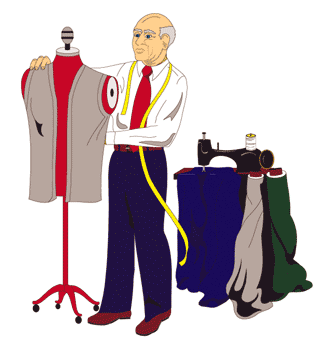
    When people go to a formal event like a banquet, they usually wear a nice suit or a dress. When they go to the lake, they put on swimsuits and wear shorts and t-shirts.  What do all of these clothes have in common?  They were all made by someone. In many places, some of the nicest clothes come from tailors or dressmakers. These experts in clothing make new suits, dresses, and other clothes or make alterations to customers’ clothes to make them as nice as possible. The job of tailor or dressmaker allows people to work with their hands and to be creative as they help people to get the kinds of clothes they want.

    Many of the clothes that people wear come from factories where workers make hundreds of the same types of clothes to sell around the world. These clothes come in standard sizes and colours, and they are generally fairly inexpensive and casual. However, what about special clothes, like wedding dresses, graduation suits, or bridesmaids’ outfits? When people need something they can’t find in a store, they might go to get their outfits specially made.

    Normally, tailors and dressmakers are not the people who design clothes. Instead, they follow premade patterns that they adapt to fit the person buying the clothes. They might also do alterations on clothes that people have bought elsewhere, such as raising or lowering the hems of pant legs or changing the size of a waistband. Whatever makes clothes more wearable is part of what tailors and dressmakers do. They often work with sewing machines but also have to know how to make clothes by hand. They have to be able to follow directions on patterns but also be flexible and creative to give customers the clothes they want.

    Tailors and dressmakers need to know a lot about how clothes are designed. They need good skills in reading and mathematics to read and understand patterns and to make calculations to alter clothes. Generally, a high school diploma is enough to get into the work, although courses in home economics are useful. The most important thing is practice. With practice, people learn the different sewing terms and learn all kinds of techniques, such as making special stitches or working with different kinds of fabric. Generally, tailors work with men’s and boys’ clothes and dressmakers work with women’s and girls’ clothes, but not always.

    Once they have the skills they need, tailors and dressmakers can work in all kinds of places. Some of them set up their own businesses in shops or in their homes. Others work in factories or in department stores. Some tailors and dressmakers work regular hours but make low wages, but experienced people in this field can often choose their own hours and make a lot of money. Getting to know the clients well and doing good work can help tailors and dressmakers succeed. If you like people and enjoy working with your hands, it could be the right job for you.

  • Volunteer Centres: Helping You Get Your 40 Hours

    Volunteer Centres: Helping You Get Your 40 Hours

    As you know, all high school students need to have 40 hours of community service in order to graduate. Use this information to discover where your 40 hours can best be used.

    Volunteer Centres work in local communities to strengthen volunteering and citizen engagement. With more than 200 in Canada, each volunteer centre’s name, size, structure and services reflect the unique characteristics of their community.

    To find a volunteer centre in your area, click here.

    Many volunteer centres are independent non-profit organizations, while others are part of a United Way, Social Planning Council, Community Information and Referral Centre or municipal services. Though diverse in many ways, they share the following common functions:

    – Promote volunteering

    – Build the capacity of organizations to engage volunteers

    – Facilitate connections between people with volunteer opportunities

    – Provide leadership on issues related to volunteering and citizen engagement

    If you want to volunteer, your local volunteer centre is there to connect you to opportunities in your community. It may have a database of volunteer opportunities or can connect you directly to opportunities within its member organizations.

  • Coiffeur/coiffeuse

    Les coiffeurs et les coiffeuses shampooinent, coupent, coiffent et traitent les cheveux en utilisant des produits chimiques. Ils peuvent aussi offrir d’autres services comme les traitements du cuir chevelu et la pose de postiches. Dans certaines provinces et certains territoires, les coiffeurs et les coiffeuses peuvent aussi offrir des services additionnels comme le service de base pour les ongles naturels, le traitement facial de base et le perçage des oreilles.

    Pour assurer leur réussite, les coiffeurs et les coiffeuses doivent réunir des compétences techniques et interpersonnelles. Le développement continu sur les plans personnel et professionnel, et le maintien de la clientèle sont des aspects essentiels pour leur réussite à long terme. Les coiffeurs et les coiffeuses peuvent recommander aux clients et aux clientes des styles selon les tendances, leurs traits physiques et leur style de vie. Avoir un sens critique, poser des questions et savoir écouter sont des habiletés importantes pour répondre aux besoins de la clientèle. Selon le milieu de travail, le coiffeur ou la coiffeuse peut recommander ou vendre des produits pour les cheveux ou pour la peau.

    Les coiffeurs et les coiffeuses peuvent travailler dans des salons de coiffure, des spas, des salons de barbiers, des écoles, des cliniques spécialisées dans la greffe de cheveux, des établissements en soins de santé, des hôtels, sur les bateaux de croisière et dans les domaines du divertissement et de la mode. Avec l’expérience, les coiffeurs et les coiffeuses peuvent occuper d’autres postes comme ceux de gérants de salons de coiffure, de propriétaires, de consultants en mode, de professeurs, de stylistes de scène et de représentants commerciaux. Les salons peuvent se spécialiser dans les soins pour femmes, pour hommes ou pour les deux. Les coiffeurs et les coiffeuses peuvent recevoir un salaire, des commissions, une combinaison des deux ou être rémunérés selon une entente quant à la location de chaise. Lorsqu’un règlement municipal le permet, certains coiffeurs et certaines coiffeuses travaillent à la maison.

    Les coiffeurs et les coiffeuses travaillent avec divers instruments et équipement incluant les brosses, les peignes, les ciseaux, les tondeuses, les rasoirs, les séchoirs à cheveux et les fers à cheveux. Ils possèdent la majorité de leurs instruments et doivent les garder stérilisés, désinfectés et entretenus.

    Certains coiffeurs et certaines coiffeuses se spécialisent dans des domaines comme la coupe, la pose de rallonges et les services utilisant des produits chimiques. De plus, la diversité au Canada nécessite une spécialisation des services propres aux ethnies.

    Les coiffeurs et les coiffeuses travaillent dans des environnements de travail propres, malgré le fait que les produits chimiques qu’ils utilisent peuvent irriter leur peau et produire de fortes odeurs et émanations. Certaines considérations physiques de cette profession sont les longues périodes à se tenir debout, une fatigue due à la posture et à la fréquente répétition de certains mouvements, ce qui peut entraîner des foulures répétitives, des maux de dos ou de pieds. Toutefois, en mettant l’accent sur l’ergonomie, on peut réduire ces effets.

    Les qualités importantes que devrait posséder une personne désirant devenir coiffeur ou coiffeuse sont de bonnes aptitudes en communication, de bonnes relations interpersonnelles, une bonne coordination et une bonne dextérité manuelle, de l’endurance et une bonne perception des couleurs et de la profondeur. Le respect, le professionnalisme, le travail d’équipe, le tact, la discrétion et la créativité sont d’importantes qualités personnelles. Pour être à jour avec les tendances et les styles, les coiffeurs et les coiffeuses doivent perfectionner leurs compétences lors de salons professionnels et d’autres activités de formation. Ils doivent également comprendre et mettre en pratique les méthodes d’hygiène personnelle et publique afin d’assurer la santé et la sécurité dans le milieu de travail.

  • Soudeur/soudeuse

    Les soudeurs et les soudeuses assemblent des morceaux de métal en appliquant de la chaleur, à l’aide d’un métal d’apport ou du processus de fusion. Ils assemblent des pièces en cours de fabrication, construisent des structures et réparent des pièces endommagées ou usées. Ils utilisent plusieurs procédés de soudage et de coupage pour assembler de l’acier de structure et pour séparer des métaux et d’autres composants métalliques contenus dans les récipients, dans la tuyauterie ou dans d’autres composants. Ils fabriquent également des pièces, des outils, des machines et de l’équipement utilisés dans les secteurs de la construction et de la fabrication.

    Les soudeurs et les soudeuses peuvent se spécialiser dans certains types de soudage comme la fabrication sur commande, la construction et la réparation de navires, l’aérospatiale, les récipients sous pression, les canalisations, la construction par soudage et la réparation de la machinerie et de l’équipement.

    Ils travaillent pour des employeurs comme les ateliers de fabrication, les fabricants d’acier et de plateformes, les raffineries pétrochimiques, les entrepreneurs en construction mécanique, les entrepreneurs en transport (machinerie lourde, aéronefs, construction navale) et les ateliers de soudage spécialisés. Ils peuvent également être à leur propre compte. Leurs travaux peuvent être exécutés à l’extérieur ou à l’intérieur et peuvent entraîner des déplacements dans des localités éloignées.

    Les soudeurs et les soudeuses doivent posséder des qualités telles qu’une bonne aptitude à la mécanique, la dextérité manuelle, une bonne vue, une excellente coordination œil-main, et la capacité de se concentrer sur un travail précis et de travailler en équipe. Ils doivent également être en mesure de travailler rapidement et avec précision, de se représenter un produit fini, de raisonner de façon logique et de comprendre la métallurgie.

    Les risques professionnels dans ce corps de métier comprennent les étincelles, les gaz, les émanations dangereuses, les brûlures, le levage de charges lourdes, l’exposition aux rayons ultraviolets et infrarouges et le travail en hauteur, dans les espaces clos et dans les tranchées. Avec de l’expérience, les soudeurs et les soudeuses peuvent progresser vers des postes comme inspecteur de soudage, chef d’équipe ou superviseur de soudage. Certains d’entre eux et certaines d’entre elles ouvrent leurs propres ateliers de réparation ou travaillent en sous-traitance comme soudeurs ou soudeuses d’appareils de forage.

  • Trades Profile: Welder

    Trades Profile: Welder

    Welders permanently join pieces of metal by applying heat, using filler metal or fusion process. They join parts being manufactured, build structures and repair damaged or worn parts. They also fabricate parts, tools, machines and equipment used in the construction and manufacturing industries.

    Welders may specialize in certain types of welding such as custom fabrication, ship building and repair, aerospace, pressure vessel, pipeline, structural welding, and machinery and equipment repair.

    They work for employers such as fabrication shops, steel and platform manufacturers, petrochemical refineries, mechanical contractors, transportation contractors (heavy machinery, aircraft, shipbuilding), and specialized welding shops. They can also be self-employed. Their work may be performed outdoors or indoors, and travel may be required to jobs in remote locations.

    Welders require attributes such as good mechanical ability, manual dexterity, good vision, excellent eye-hand coordination, the ability to concentrate on detail work and work as part of a team. They also require the ability to work quickly and accurately, to visualize a finished product, to reason logically and to understand metallurgy.

    Occupational hazards in this trade include: sparks, gases, hazardous fumes, burns, heavy lifting, exposure to ultra-violet light and infra-red rays, working at heights, in confined spaces and in trenches.

    With experience, welders may advance to positions such as welding inspector, lead hand or welding supervisor. Some welders open their own repair shops or work as rig welders, contracting out their services.