Category: Nature Watch

  • Volunteering Abroad – A “Travel Bug” Cure!

    Volunteering Abroad – A “Travel Bug” Cure!

    Imagine what it would be like to travel the world when you finish high school. Just think of walking along the Great Wall of China, seeing the ancient tombs and Pyramids of Egypt, or exploring the Coliseum in Rome. If you have the “travel bug” you might find the idea exciting. Unfortunately, travelling to see these places can also be very expensive and could cost much more than you can afford. However, you might still be able to see the places you want without using up all of your money. One of the best ways of doing this is through going abroad for short-term or long-term volunteer assignments.

    Depending on what you want from travel, a volunteer assignment could be an ideal way of seeing the world. Tourists tend to stay in hotels and to visit the standard tourist sites like historic buildings, museums and monuments. They frequently avoid eating much of the local food in case it makes them sick. Usually they have very little contact with the people of the country, other than tour guides or staff in hotels and restaurants. For some tourists, getting away is not much different from being at home.

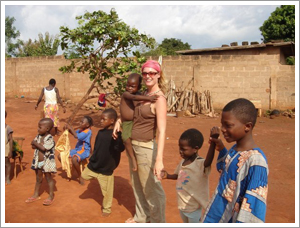
    Volunteers, on the other hand, usually get to know about everyday life in the places they visit. They frequently work together with the local people on projects directly related to the people living in the region. They might help build schools, work with orphans, study the habits of animals, or even help dig up ancient monuments. They might teach English or help with the children at the local school. Special skills might be necessary for some assignments, but strength and the ability to work hard in the sun might be all that’s needed for others.

    Some volunteer assignments might last for a few weeks or be part of an ongoing service to the local people. Many volunteer organizations offer both short-term assignments that last a few weeks and long-term assignments that can last several months or even a few years. A short assignment might fit well during summer holidays, while others might need to wait until you can take a year off to go somewhere for a longer period of time. If you’re thinking of volunteering abroad, it’s a good idea to check with several different organizations to see which one is the best fit for you.

    Another question to consider is the cost. Most short-term overseas volunteer programs involve some payment to cover the costs of expenses such as housing and food. There are often additional costs such as airfare to and from the assignment. In exchange you’ll get far more help and support than you would ever get while travelling alone. The costs might even be lower than for other kinds of travel. If you like the idea of seeing the world but want the safety and comfort of having help from other people, volunteering abroad might be the right choice.

    Does volunteering abroad sound good to you? If so, it’s never too early to start finding out about the possibilities you can consider!
  • The Great Pacific Garbage Patch: Filling the Ocean with Plastic

    The Great Pacific Garbage Patch: Filling the Ocean with Plastic

    Have you ever been to a garbage landfill? Have you seen cities where the garbage lies on the street without ever being cleaned up? If you have, you know all about the smell and the general unpleasantness. Did you know that the biggest landfill in the world is actually not on land but in the water? Far out in the Pacific Ocean is an area called the Great Pacific Garbage Patch, where plastic and other litter has been floating around and polluting the water. The patch is a major concern for scientists and other people who want to keep the oceans healthy.

    The world’s biggest garbage dump is made up of two sections in the Pacific Ocean, one between California and Hawaii and the other off the coast of Japan. The two sections are connected by a current called the Subtropical Convergence Zone and together make up the Great Pacific Garbage Patch. The area where the Garbage Patch is located is called the North Pacific Subtropical Gyre, a section of slowly spinning water. The area is often called an oceanic desert since it has very few plants or animals other than tiny plankton.

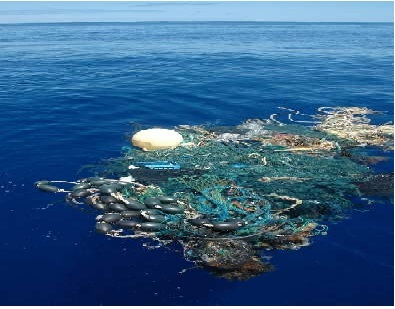
    Instead of animals, however, the North Pacific Subtropical Gyre has huge amounts of garbage, about 90% of which is plastic. The trouble with plastic is that it never completely disappears but instead photodegrades, breaking into smaller and smaller pieces of plastic called “mermaid tears” or “nurdles.” Garbage can float around in the ocean for years or even decades, but eventually it ends up in one of the garbage patches, often floating just below the surface or sinking down to the ocean floor. Some scientists estimate that the size of the garbage patch could be as big as the state of Texas, although others believe it to be much smaller. However big it is, it’s a cause for concern.

    As the pieces of plastic or other garbage float around in the water, they pick up poisons from fertilizers and other substances that wash into the ocean or they join other kinds of garbage floating in the water. Thousands of birds and marine animals, possibly up to a million every year, die from eating or being caught in the ocean’s garbage. Debris that floats in towards the land pollutes beaches along the coasts of countries like Japan and Canada, sometimes even piling up several feet high in some areas.

    Where does all of this garbage come from? Some of it comes from people dumping trash from ships, but about 80% of it comes from land. It could be garbage carried by the wind from landfills or from city streets, which eventually makes its way to the ocean. It could come from litter that people drop into in the lakes and rivers before it floats down to the oceans. That’s why some towns have banned plastic grocery bags, which make up a large part of the litter. In some towns and cities, volunteers help to clean up beaches and other areas where garbage accumulates.

    Every small change can help to get rid of garbage in the oceans. What will you do to keep the world’s water clean?

  • Whales of the Bay of Fundy

    Whales of the Bay of Fundy

    The Bay of Fundy is located between New Brunswick and Nova Scotia and is home to the world’s highest tides. The tides range in height from 11 feet to 53 feet depending on location. They change between high and low tide twice a day, carrying with them a hundred billion tons of water.

    The story of the Bay of Fundy, as told in Micmac lore says, “It was a giant whale, who angered the god Glooscap, and created such a splash with his mighty tail that the water sploshes back and forth to this day.” Although this story is entertaining, scientifically speaking the Bay’s tremendous tides are formed by its unique shape, which was created hundreds of millions of years ago.

    In the summer months the Bay of Fundy is the feeding ground for half of the world’s population of endangered North American right whales and 12 other species of whales. They feast on the enormous amounts of krill, plankton, squid and schools of young herring, cod, pollock and mackerel. It is also the preferred location for whales to give birth, mainly because of the vast amounts of food available and due to the protection the bay provides. At any given time the population of whales in the area ranges between three and four hundred.

    The first species to arrive in late spring are the finback and minke whales and harbour porpoises. The endangered right whale usually arrives in mid-July and stays until Fall.

    The most common whales in the Bay of Fundy are:
    The Minke Whale: Can grow up to 30 feet and weigh up to 10 tons. These whales travel in pods of 2 or 3, and can dive for up to 25 minutes without surfacing for air.

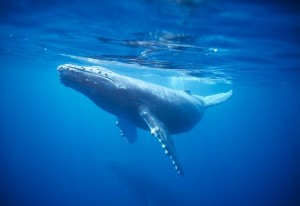
    The Humpback Whale: Can grow up to 60 feet and weigh up to 30 to 50 tons. The females of the species are usually larger than the males. These whales enjoy spy hopping, breaching and tail lobbing and usually put on a good show for those who go whale watching.

    The Finback Whale: The second largest whale in the world (next to the blue whale) and generally only frequent the bay during their migration periods, when they are seen following their food sources. The finback can grow up to 82 feet in length, and they usually travel in pods of 2 to 7 whales. They can even live for up to 100 years.

    The North American Right Whale: The most endangered species of whale in the world. There are fewer than 35 left worldwide. These whales migrate to the Bay in the summer months to mate. They can grow up to 50 feet and weigh up to 45 tons.

    The best time to view the many different species of whales found in the Bay of Fundy is August.

  • Sports and Volunteer Hours

    Sports and Volunteer Hours

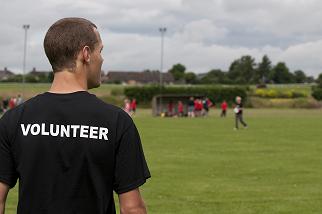
    With the cold now upon us, many of us are dreaming of next summer. During the summer months, the last thing you want to think about is school and especially about completing those mandatory volunteer hours so you can get your high school diploma. Not to worry, though! You can still have plenty of fun in the sun while completing those volunteer hours.

    How do I know that you can do this? Well, I know from personal experience of course. Just like all of you readers, I had to manage my time in the summer so I could complete my volunteer hours. I decided that since I have to do them, I would want to volunteer for something that I would enjoy. In my case, I liked sports, so I phoned some local sport clubs and asked if any were offering volunteer hours for students.

    After some sport searching, I discovered that I could coach for a junior league soccer team. As intimidating as coaching sounded, I was up to the challenge, and it turned out to be one of the best parts of my summer. I signed up, along with my brother, and we coached a soccer team for 8 year-olds soccer  for two months.

    We practiced once a week and played a game every weekend, putting in over 3 hours a week. It was a very small amount of time we had to take out of our normal summer, and it wasnʼt agonizing to do. In fact, I looked forward to seeing my kids learn and develop soccer skills through mine and my brotherʼs coaching. It was very rewarding, especially when we made it all the way to the finals and won the
    championship!

    Jamie Willett, a recent resident at Western University, had a similar experience with her high school volunteer hours. Jamie did her volunteer hours spending her summer assisting a junior gymnastic team. She spent hours every week planning and executing lessons for a group of young gymnasts.

    “It was really thrilling to teach the kids during the summer. Although it brought new challenges everyday, it allowed me to test my skills as a gymnast and as a teacher. It definitely helped me discover what I wanted to do after high school as well!”

    This fall term Jamie will be studying at teacher’s college at Western University for a year so she can teach students at the high school level.

    As you can see, there are plenty of ways to finish up those volunteer hours during your high school years and we have only covered the realm of sports! Be sure to check out the Jobs People Do Volunteer section to check out where you can lend a hand in your community!

    Start thinking about and planning your summer volunteer opportunities now!

  • Cardboard Bicycles: Would YOU Ride One?

    Cardboard Bicycles: Would YOU Ride One?

    Every morning, people around the world get up and take their usual transportation to work or school. But what is their usual transportation? In North America it might be the car, but it’s a different story in many other parts of the world. In most countries, the most common form of transportation is the bicycle. According to National Geographic, people around the planet own 800 million bicycles – which is twice as many as the number of cars. New technology in the bicycle world can affect the lives of millions of people worldwide, just as it did almost two hundred years ago.

    People have dreamed of riding on wheels for centuries. In the 1400’s, the inventor Leonardo da Vinci developed the idea of a machine like our modern bicycles but never made one. In 1840, an inventor from Scotland rode more than sixty kilometres on a two-wheeled machine operated by a foot-powered treadle. Twenty years later, a French inventor developed the idea to include cranks and rotating pedals, much like modern bicycles. In 1860, people first started to use the term “bicycle” for the new machine.

    Air-filled (pneumatic) tires were the next development in the bicycle’s story. Next, people developed different bicycles for all kinds of uses: sleek and lightweight racing bikes, heavy but sturdy all-terrain bikes and much more. The basic structure is the same, however: a metal frame with air-filled rubber tires which help to cushion the rider against bumps in the road. These bikes can be expensive to buy and they need frequent maintenance (especially for punctured tires), but who would think of making them any other way?

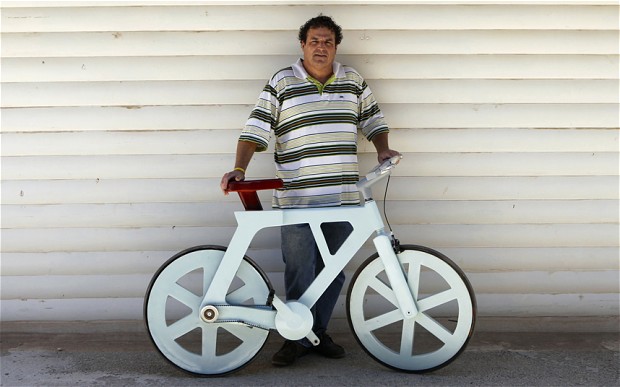
    An Israeli inventor named Izhar Gafni hopes to solve the some of the traditional bicycle’s problems with his new invention: cardboard bicycles with solid rubber tires. The tires, made from recycled rubber car tires, can’t get punctured because they have no air in them. Almost all of the rest of the bicycle is made from recycled cardboard, with a car’s timing belt instead of a chain. The outside of the bicycle is covered with a special coating to make it waterproof and fireproof and is then painted. Each bicycle weighs about nine kilograms instead of the usual fourteen kilograms for metal bicycles.

    The low-cost of the new bicycles could make a huge difference in places like Africa, where people might not be able to afford a traditional bike. Even if the bicycles last only a few years, they could give people the transportation they need to go to school, go to their jobs and maybe even get out of poverty. When these bicycles come into stores, they will likely cost about $20 instead of the hundreds or even thousands of dollars a metal bike can cost.

    If Izhar Gafni’s invention works, it could affect much more than just bicycles. Airplanes or cars made out of cardboard would be much lighter than metal ones and use less fuel, making travel cheaper. It could change the world’s transportation systems forever.

  • An Energy Plan Must Be About More Than Just Energy

    An Energy Plan Must Be About More Than Just Energy

    Feeding our energy appetite is top of mind for many people these days. Some argue we should get coal, oil and gas out of the ground as quickly as possible, build more pipelines and make as much money as we can selling it here and abroad. Their priorities are the economy and meeting short-term energy needs so we can live the lives to which we’ve become accustomed.

    Many others question those priorities. Do we gain comfort and happiness by driving inefficient automobiles, buying and scrapping and then buying more stuff that we must work harder to pay for, and selling resources to enrich the fossil fuel industry and to allow other countries to follow our unsustainable path?

    Some governments and industry favour the short-term view. But it’s a “false economy” — it will cost us more in the long run. What about our children and grandchildren and their children and grandchildren? Do we not want them to live healthy and happy lives? If we pollute the air, water and soil that keep us alive and well, and destroy the biodiversity that allows natural systems to function, no amount of money will save us.

    While rushing to exploit our valuable and diminishing fossil fuels, Canada’s government is simultaneously “streamlining” environmental regulations and review processes, cutting scientific staff and departments and limiting public debate on projects that could irreparably damage our rich natural heritage. Some provinces are attempting to water down hard-won environmental laws, like endangered species legislation, that act as a critical hedge against environmental degradation.

    The federal government is also neglecting its legal obligations to protect species at risk. Ecojustice, on behalf of five conservation groups including the David Suzuki Foundation, recently launched a lawsuit to challenge the government’s multi-year delays in producing recovery strategies for species that would be affected by the proposed Enbridge Northern Gateway project.

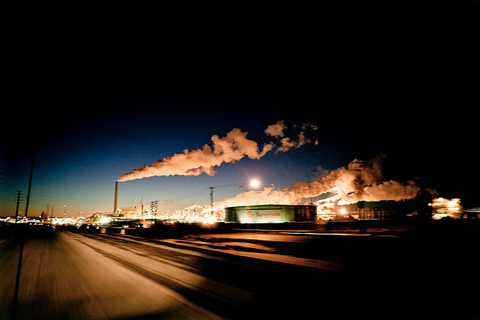
    If we don’t slow down and try to look at ways out of the mess, energy issues will continue to increase, like the Hydra of Greek mythology. With pipelines, the main issue is rapid tar sands expansion. But other massive energy projects are also coming down the pipe — from huge dams, like the Site C in northern B.C., to proposed drilling for oil and gas in the Gulf of St. Lawrence and the Arctic. To what end?

    Not only are fossil fuel companies making record profits, they’re being subsidized by Canadian taxpayers to the tune of $1.4 billion a year. Instead of giving them money, shouldn’t we be compelling them to put at least a small portion of their enormous profits into reducing the massive greenhouse gas emissions they cause?

    A large part of the problem is that we are increasing our fossil-fuelled ambitions at breakneck speed in the absence of a national energy strategy. No one seems to know where we’re going, but the end of the road is looming, and it might lead to a steep drop. We’re already harming precious ecosystems and are ready to put even more at risk without having an idea of the often irreplaceable value they represent. With climate change and its impacts, along with deforestation, pollution and increasing urbanization, we’re condemning millions of people to lives of poor health, desperation and even death.

    Still, we’ve also created much that is good. We have political systems that encourage public debate and access to information. There are politicians and industry leaders who have joined countless citizens, First Nations, and environmental, labour and social-justice organizations to question current policies and actions. We have science, medicine and technology that have allowed many of us to live longer. We need to find ways to reconcile our existence with the limits of our finite planet.

    What Canada really needs in the short term is a national energy strategy — one that goes beyond fracking and tar sands and pipelines to take into account these many other factors, including wiser use of fossil fuels. It must help us make the transition from our wasteful addiction to polluting and ever-diminishing fossil fuels to conservation and renewable energy. Globally, we need to shift from the outdated 20th-century notion of measuring progress with gross domestic product to a development paradigm that takes into account well-being and happiness, and that accounts for nature’s valuable services.

  • Volunteer Centres in Canada

    Volunteer Centres in Canada

    As you know, high school students require 40 hours worth of volunteer work/community service in order to graduate. Use our handy guide below to discover how your hours can best be used!

    Volunteering and Community Hours

    What is a Volunteer Centre?

    Volunteer Centres are non-profit organizations or groups dedicated to fostering and developing volunteerism in the community as a whole. While other organizations contribute to sustaining our national heritage of volunteering through their programs and outreach, Volunteer Centres serve the broadest membership; this includes volunteers and organizations/volunteer-involving organizations. Volunteer Centres reach across the non-profit and public sectors to include organizations working in human and social services, health care, education, the arts and recreation – regardless of their source of funding.

  • Gum Recycling

    Gum Recycling

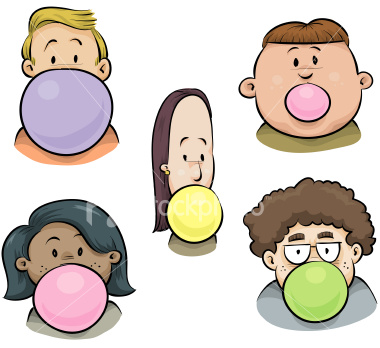
    Do you ever chew gum? How many times have you heard your parents or teachers tell you to put your finished gum in the garbage instead of spitting it out onto the sidewalk or leaving it under your chair? That’s good advice, since no one likes to have gum stuck to the bottom of their shoe or on their clothes or hair. Gum is sticky, and it can create a mess that is very difficult to clean up. Even in the garbage, however, gum can be a problem, since it never biodegrades. It would be far better if the gum could be reused or turned into something different. What if you could reuse gum and make it into a chair, a plastic container or fertilizer? Some scientists and inventors have found ways to turn discarded gum into many different products, and it’s helping to make cities cleaner.

    Cleaning up used chewing gum might not seem like a big problem, but it can be very expensive and difficult for city governments. According to research company Euromonitor International, Canadians bought more than 15,600 tonnes of gum in 2011. Much of that gum ended up on the streets. In one small area of a Toronto sidewalk, city officials once counted 2000 gum stains. Getting rid of that much gum can be difficult because it’s so sticky.

    One way to get rid of discarded gum is to use high-powered hoses that spray water and chemicals, but that can be expensive and wasteful. In Calgary, the government spends $50,000 each year on removing gum just from its light rail train stations, besides the money it spends to remove it elsewhere. The process ends up wasting a lot of water, as well as uses chemicals that might harm the environment. However, gum recycling might help to provide a solution for the problem.

    One of the first people to discover a way to recycle gum was a student named Anna Bullus from England, who found a way to change gum, which is made of rubber, into plastic. She now uses this plastic to make bright pink Gumdrop Bins where people can put more of their used gum. The bins come in 250-piece and 500-piece sizes and are appearing all over the country.

    Officials at the Southampton Airport in southern England, for example, claim to have the first airport in the world with gum recycling bins. Some of the gum from these bins ends up being recycled into a rubbery material used for construction and for running tracks. Some of the gum even ends up as toys. The United Kingdom already has a thousand gum bins in bus depots, train stations and other public areas. Some people estimate that the bins have reduced gum litter by 75%, and the project is still growing.

    Gum recycling is also coming to other parts of the world. Gumdrop Bins have appeared in an amusement park in the United States. In Canada, a company called Envyrobubble collects gum in 1000-piece containers and recycles it into fertilizer. If the idea of gum recycling catches on, who knows where it might appear next!

  • Online Learning: The Best Sites On The Web!

    Online Learning: The Best Sites On The Web!

    Finding information on any given subject is as easy as clicking a button on a search engine. Gone is the need for rows of encyclopedia’s, dictionaries and tangible books. Everything is available online at your discretion. Wading through the options, however, can take the shine off of the ease of accessibility. If you are looking for something specific, you still need to wade through your choices until you find a reliable source. This is not as easy as it sounds. Wikipedia, the wonderful, epic, online encyclopedia, is not considered a trustworthy website as it is user-generated. Literally any one can add and edit information at their discretion.

    Yet the World Wide Web is an amazing resource of quality material, knowledge from experts and an educational smorgasbord at your fingertips. It is argued that a quality education should not cost as much as some private universities are charging and that influential change makers are creating ways to offer learning opportunities through the internet that are solid and authentic. So how can you navigate your way through the dead ends, cobwebs and arm chair educators to find what you need? With a little research and a lot of time you can hunt out the best, but I have compiled a list of quality geography, history and science sites to get you on your way.

    Seterra is a geography program that offers a free download for a multiple level map game. Players choose their continent and go from there with either a wide focus, such as labeling the countries, or a more narrow one, such as finding the capital cities. The great thing about Seterra is the fun factor. It is easy to become addicted to improving your score and to forget that you are learning!
    www.seterra.net

    National Geographic is a trusted name and the organization has done a fabulous job of utilizing the internet to engage students of all ages with a variety of learning strategies that often come under the guise of games and videos.
    www.nationalgeographic.com
    http://kids.nationalgeographic.com/kids/

    The History Place is a gift to those who appreciate the past and love to dig deeper. It is a website filled with detailed information and pictures. The site has also won numerous awards.
    www.historyplace.com

    Ted Talks is an amazing website with hundreds of video presentations about ideas worth spreading by innovative change makers from around the world. You can find just about anything worth knowing about on this website.
    www.tedtalks.com

    Khan Academy is a free world class education that changed the way people learned online. It recently got a grant of money which has resulted in a lot more lessons and a lot more exposure.
    www.khanacademy.org

    BBC history section is an incredible source of material, both compelling and richly informative. Anyone who visits this website leaves with a better understanding of the world we live in.
    http://www.bbc.co.uk/history/0/

  • Fresh Air Is Good For You

    Fresh Air Is Good For You

    Fresh air is good for you; it’s as simple as that. High school, college, university, academia or whatever path you choose to follow can be tiring and stressful. Long hours combing through forgotten history textbooks, memorizing flow charts and questioning minute details of your latest assignment can, and often will, be central to your formal education. So take a break – get outside!

    This isn’t a new concept. Many of us were fortunate enough to have parents push us out the backdoor when we were younger despite how much we wanted to watch just five more minutes of television or play one last level of our video games. Apparently they were right after all.

    With our technological era, the roles, responsibilities and resources of and for students are increasingly found behind the warm glow of a computer screen. Though such advances allow access to information and creates communication possibilities that our parent’s generation could never have dreamed of, it’s important not to forget the world beyond online academic databases, social networks and online video.

    Whether it’s a walk to the grocery store, a jog or finding a spot in a nice piece of shade, the outdoors can prove to be a welcome change from the fluorescent lighting, long lectures and minuscule texts typically found on campus.

    If you’re having trouble concentrating, how about a walk? If you’re experiencing a mental block, try working in a different environment (maybe your back porch?). Getting fresh air doesn’t necessarily mean excessive physical strain or avoiding your academic responsibilities. It can be as simple as sitting on a lawn chair or taking the scenic route back from your classes. It can be a welcome break, a stress reliever or just plain fun.

    Being outside, and physical activity, has its obvious benefits as well. One issue that many students face, particularly when beginning their post-secondary studies, is malnutrition and the dreaded weight gain of the “freshman 15”.

    For the first time, especially if going away for school, you will be in charge of your own physical fitness and for many this can be difficult. Sometimes there are too many temptations in the school cafeteria, or the ease of fast food during exam time is far too alluring. Physical fitness and personal well-being is an important part of student life and one that is often understated.

    So get outside! Whether for your physical well being, to help cope with academic stress and emotions or just for some fresh air, don’t forget there’s a world outside of the school’s facilities.

    You won’t regret it, I promise.