Category: Nature Watch

  • Getting Your 40 Volunteer Hours

    Getting Your 40 Volunteer Hours

    As you know, all high school students need to have 40 hours of community service in order to graduate. Use this information to discover where your 40 hours can best be used.

    Volunteer Centres work in local communities to strengthen volunteering and citizen engagement. With more than 200 in Canada, each volunteer centre’s name, size, structure and services reflect the unique characteristics of their community.

    To find a volunteer centre in your area, click here.

    Many volunteer centres are independent non-profit organizations, while others are part of a United Way, Social Planning Council, Community Information and Referral Centre or municipal services. Though diverse in many ways, they share the following common functions:

    – Promote volunteering

    – Build the capacity of organizations to engage volunteers

    – Facilitate connections between people with volunteer opportunities

    – Provide leadership on issues related to volunteering and citizen engagement

    If you want to volunteer, your local volunteer centre is there to connect you to opportunities in your community. It may have a database of volunteer opportunities or can connect you directly to opportunities within its member organizations.

  • Students Going Green

    Students Going Green

    Focusing on the sustainable environment as a student can help you reduce your ecological footprint while at the same time stepping in the right direction for your future career path.

    As the global warming debate increases its heat in society, universities are picking up on the need to teach students the importance of being environmentally friendly in their future places of work.   The Calgary Herald recently stated that “so-called “green jobs” are growing at more than twice the rate of traditional jobs in Canada–9.1 per cent over the last decade compared with the average of 3.7 per cent”(Sankey, 2009). Starting to incorporate sustainable thinking into your student life not only does the obvious, which is to help the environment, but can give you a competitive edge in a job market that is increasingly catering to environmentally friendly applicants.

    Many colleges and universities are offering programs that are entirely environmentally focused.  If you are passionate about the environment, this is a great route to take, as it will allow you to not only embrace your passion, but enter a growing and dynamic industry.  Some examples of environmentally focused programs are:

    • Trent University’s degree in Environmental and Resource Studies
    • York University’s Faculty of Environment offers a wide variety of environmentally focused programs ranging from environmental design to ecofeminist politics.
    • Seneca College’s Environmental Technician program

    This is just a small sampling, and most post secondary institutions offer similar programs.  If a program entirely devoted to the environment is not for you, try to take some sustainability focused course along your educational path.

    Incorporating environmentally friendly thinking into your everyday campus life will not only contribute to improving the natural environment, but can help you to obtain skills and knowledge that will give added value to your employers in the work place.  Here are some great ways to be environmentally friendly in your university life:

    • Walk, bike, bus to school.  Many schools offer bus passes included in tuition or a discount on monthly passes.  As well, Bixi Bikes, available in places like Toronto and Montreal, is a great way to get around (Bixi Bikes, 2010).  Bixi Bikes provides the ability to rent a bike from one location, and drop it off at another.  On campus parking can be expensive and scarce, so alternative transportation is not only great for the environment, but also great on your wallet.
    • Buy used text books instead of new ones, which is also a wallet-friendly environmental move.
    • Save paper! If your professor allows it, email in assignments instead of hard copies.  If you are required to hand in hard copies, print on both sides!
    • Bring a travel mug to school for your coffee – most coffee places will offer you a discount.  When you think of all the time spent at school, and all the coffees you will drink, the savings can actually add up! The same goes for reusable bottles for water.
    • If you are doing your own groceries, bring a backpack and reusable bags to the grocery store.  If you are eating in the cafeteria, bring a container for leftovers so you do not waste food, and get a snack for later.

    A pro-environmental attitude in university can be a spring board for a lifetime focus on sustainable living, which will only become increasingly important in years to come.

  • We Can Make Canada’s Reality Match Its Image

    We Can Make Canada’s Reality Match Its Image

    Canada is blessed with some of the last vestiges of pristine nature on Earth — unbroken forests, coastlines and prairies, thousands of rivers, streams and lakes, open skies, abundant fresh air. Many of us live in urban areas, but our spectacular landscapes are embedded in our history and culture. They define and shape us as people.

    We are also defined by our Constitution, which is far more than a set of legal prescriptions. It embodies our highest aspirations and values. As our nation’s top law, one would expect it to reflect our connection to the land, air, water and wildlife that keep us alive and healthy. Our Constitution’s Charter of Rights and Freedoms gives us freedom of expression, equal protection from discrimination and the right to life, liberty and security of the person. But it doesn’t mention the environment. How can we fully enjoy our freedoms without the right to live in a healthy environment?

    Some Canadians are further ahead than others. Quebec’s Environmental Quality Act and Charter of Human Rights and Freedoms both include environmental rights. Other provinces and territories — including Ontario, the Yukon, Northwest Territories and Nunavut — provide limited environmental rights. Worldwide, 110 countries enjoy constitutional rights to a healthy environment, and 181 of 193 UN member countries support recognition of such a right. Canada and the U.S. are among the exceptions.

    The sad truth is that Canada fares poorly among wealthy nations on environmental performance. A recent ranking by the Washington-based Center for Global Development puts Canada last of 27 industrialized nations. The Conference Board of Canada rated our country 15th out of 17 industrialized nations for standards on air pollution, climate change, water and other environmental factors. And the World Health Organization reports that 36,800 premature deaths a year and 13 per cent of illnesses and injuries in Canada are related to exposure to environmental hazards — costing us tens of billions a year in health-care expenses and lost productivity.

    The benefits of constitutional protection of the environment are many and the drawbacks few. In places with such a right, people have legal avenues to protect them from activities that pollute the environment and put human health at risk.

    For example, Argentina’s constitutional environmental-rights protection was used in a case where industrial pollution was seriously affecting the health of people along the Matanza-Riachuelo River. After residents sued the national, provincial and municipal governments and 44 corporations, Argentina’s government established clean-up, restoration and regional environmental health plans. It has increased the number of environmental inspectors in the region from three to 250, and created 139 water, air and soil quality monitoring points. There’s still much to be done, but three new water-treatment plants and 11 new sewage-treatment plants mean millions of people now have access to clean water and sanitation. Many garbage dumps and polluting industries were shut down. And the local economy benefited.

    A legal right to a healthy environment is not about hamstringing corporations; it’s about ensuring they’re run responsibly and that people’s health and well-being come first. It’s also about ensuring laws are enforced and penalties imposed when they’re violated. The total amount of fines imposed under the Canadian Environmental Protection Act from 1988 through 2010 (about $2.4 million) amounted to less than what the Toronto Public Library collected in overdue-book fines in one year, 2009 (about $2.7 million)! And it’s not a right-versus-left political issue. Jacques Chirac, France’s conservative president from 1995 to 2007, made constitutional recognition of the right to a healthy environment one of his priorities. More than 70,000 French citizens attended public hearings on the issue andFrance’s Charter for the Environment was later enacted with broad support from all political parties.

    Evidence suggests that stronger environmental regulation spurs innovation and competitiveness, so the right to a healthy environment can benefit the economy. In the aftermath of the Walkerton disaster, Ontario strengthened its drinking-water legislation, which stimulated development and growth of the water-treatment technology sector. Countries with constitutional environmental protection, such as Norway, often enjoy high economic and environmental standards.

    It won’t be easy to get the right to a healthy environment enshrined in Canada’s Constitution. But with public support and small steps along the way — such as encouraging legal protection from municipal, regional and provincial governments —we can make it happen.

  • Old Growth Forests 101

    Old Growth Forests 101

    Why are old-growth forests important?

    When thinking about healthy forests, it’s not often that we think about dead, dying or diseased trees but any forest manager will tell you that they’re an essential part of a healthy forest ecosystem, and a key characteristic of old-growth.

    Dr. Bill Freedman, a professor of biology at Dalhousie University in Halifax, Nova Scotia, and Chair of the Nature Conservancy of Canada’s (NCC’s) National Board of Directors, explains that “old-growth forest contains some large and old trees, but all age classes are present.” Old-growth forests exist because they have not been subjected to a significant disturbance such as wildfire or clear-cutting for a century or more. Overall, it’s not easy to pin down an age at which a forest becomes “old,” because depending on the climate, geography and soil, a forest’s composition and lifespan will vary drastically.

    So what makes old-growth forests unique, and why are they important? The first answer is that old-growth forests contain trees in all phases of their life cycle, from saplings, to mature trees, to dead standing trees and finally, as rotting trees on the forest floor. This provides a home for many species of plants, fungi, invertebrates, salamanders and snakes, and makes old-growth forests hotspots for biodiversity and a refuge for high concentrations of species at risk.

    “Protecting old-growth forests means respecting the elders, letting them die a natural death and crash down, even if they’re diseased,” notes Mark Stabb, NCC’s Central Ontario Program Manager. Dead trees significantly change the structure and composition of the forest, but there are always saplings waiting in the shadows to take their place. “This helps us understand how they will respond to disease and natural disturbances such as fire, tornadoes or earthquakes,” says Stabb.

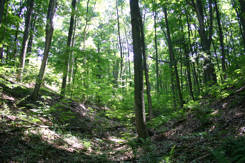
    “There aren’t many old-growth forests left compared to a couple hundred years ago,” he adds. But the 200-year-old Happy Valley Forest (HVF) Natural Area in Ontario is a good example of a forest that is growing old. Located just 35 kilometres from Toronto, this 2,851-acre (1,154-hectare) forest is an outstanding example of mature Sugar Maple and beech forests characteristic of the Oak Ridges Moraine. The HVF is critical habitat for over 110 breeding bird species, including the nationally significant Acadian Flycatcher and Cerulean Warbler and amphibians like the Jefferson Salamander.

    Dr. Henry Barnett, whose land NCC helped protect in the HVF and who has been instrumental in convincing neighbours to put their land under conservation protection, remarks, “with more than 210 acres (85 hectares) protected so far, hopefully the Happy Valley Forest will have a chance to become truly old-growth in the years ahead.”

    Provided by Nature Conservancy Canada

    www.natureconservancy.ca

  • Don’t Put Off Your Volunteer Hours!

    Don’t Put Off Your Volunteer Hours!

    Second semester is creeping its way into your life, pressure from exams have fled, and you are starting as fresh as an untouched blanket of winter snow (depending on your geographic climate, substitute snow for a bed of grass). This may be an opportune time to begin those volunteer hours you have put off “for next year” since grade 9.

    So where do you start volunteering? The first place to look is within your school community. Volunteering your time to benefit the environment of your school is a great way to establish a substantial rapport with teachers and peers alike. This does not mean you should ask your automotive teacher if he needs any work done on his front lawn! Try and find things that help the community as whole, and not just individuals you know personally. For example, you can help out with school events that may include, but are not limited to: environmental/horticultural projects, school plays, events, and fundraisers. Helping out in scenarios like the ones mentioned will not only get you some community hours, but can also foster connections with people you may have never thought about talking to! There are also clubs and teams that need assistance every once in a while. The school football team will always need a field marker for their home games! However, if you can not find anything remotely close to these examples at your school, talk to you guidance counselor and they will be happy to aid you in your quest to
    support your community!

    Letʼs not forget the great world outside of your school! Helping your own neighbourhood is also a beneficial way to not only get the hours you need for that diploma, but you can also tailor your time volunteering to gain skills you can put on a resume or use in an interview. For example, if you want to become a teacher, tutoring students after school will allow you to explore some aspects of the career. If you are thinking about nursing or becoming a doctor, helping at your local hospital may give you more of an understanding and appreciation for those professions. On the other hand, it may lead you toward never wanting to catch a cold again! Nevertheless, donʼt just volunteer for the sake of getting those hours out of the way, think about what potential careers you might want to investigate and use the volunteer hours as an opportunity to explore! Also, do not be afraid to check out universities around your neighborhood to see if they want help as well. The harder you search, the more rewarding the experience will be!

  • Outdoor Therapy

    Outdoor Therapy

    The benefits of outdoor activity are well known. Whether you’re hiking, biking, swimming, or running, these activities are all great ways to get your heart rate up and stay healthy. However, less physically demanding outdoor activities (such as gardening or washing a car) are also good for your health. Mental health, that is. Sometimes just being outdoors makes you feel good, and it’s no wonder. Fresh air, open space, sunshine, greenery…who doesn’t love these things? Especially after being cooped up in an office or classroom for hours on end every day, being outdoors is a sure-fire way to boost your mood and make you feel more relaxed.

    The positive influence of the outdoors is so great that it is even being recommended as a form of therapy in and of itself.1 Instead of relying on pharmacological intervention, some therapists recommend “outdoor therapy” as an alternative way to help people with affective disorders (such as depression).2 In general, it has been found that people who try outdoor therapy experience “improvements in self-concept, self-acceptance and more realistic self-perceptions, and reduced conflict, depression, and anxiety.”3 These effects have been shown with a variety of individuals of all ages, genders, races, personality types, and mental health statuses.4 Of course anyone can benefit from outdoor therapy, even if you’re simply having a bad day or are feeling a little under-the-weather.

    There’s no one particular activity which is recommended above others as the best form of outdoor therapy; however, it has been noted that a short camping trip (even a mock-camping trip in one’s own backyard!) can be a remarkably effective way to reduce stress, anxiety, or bad mood.5 This may be due to the fact that camping is meant to take you away from the hustle and bustle of everyday life where most of one’s stress originates. When you’re camping you don’t have to worry about studying for an upcoming midterm or fret about that long list of things “to do.” In fact, when you’re camping the only things you really need to worry about are what you’re going to cook for your next meal and keeping ample wood on the fire. I wouldn’t necessarily classify these things under “worries,” however. Even though it may just be for a couple days, camping allows you to relax and rejuvenate, leaving you feeling refreshed and ready to once again tackle all life’s challenges. Granted, not everyone considers giving up all connections to civilization for a weekend foray into the depths of the wilderness to be a relaxing experience. If you don’t like camping, then it probably won’t help to ease your stress or anxiety. Conversely, it will probably increase your bad mood, which would be counter-productive. That’s why outdoor therapy can be tailored to individual preferences. If you’re an athletic person, then maybe going for a run or hiking with some friends will boost your mood. On the other hand, if you just need some time to yourself and prefer something a little more low-key, then just grab a book and head to the local park for a quiet afternoon.

    So next time you’re in a bad mood, feeling stressed out, lonely, overwhelmed, frustrated, or you simply want some alone time- head outside and try some outdoor therapy. Whether you decide to go for a five kilometer run or grab a coffee and read a good book, you’ll be amazed at how much better you feel after stepping outside to clear your mind.

  • Great Changes for the Great Lakes

    Great Changes for the Great Lakes

    Across the world North America is known for many things; the culture, the people and the great outdoors. Part of that great outdoors is the Great Lakes. The Great Lakes are an integral part of our North American identity; and to preserve that identity in 2005 the premiers of Ontario and Quebec and the leaders of eight American states that border the lakes came together and signed the Great Lakes Water Pact.

    The Great Lakes Water Pact is a pact that has introduced strict regulations in regards to the usage of the Great Lakes and it has sunk the tentative thoughts of shipping water to thirsty regions in the United States and Middle East. It was signed by the Canadian provinces and the American states that surround the Great Lakes; Ontario, Quebec, Ohio, New York, Pennsylvania, Michigan, Indiana, Illinois, Wisconsin and Minnesota. The agreement includes rules that make it difficult for communities surrounding the Great Lakes watershed to use the water and also aims to prohibit the commercial export of the lake water by restricting withdrawals of water to five gallon (twenty litres) containers.

    The affects this pact has on future generations are great. The Great Lakes are a natural resource that are depleting and are not renewing as fast or as much that is necessary. More than thirty five million people rely on the lakes for drinking water, and the lakes are only able to replace one percent of that per year.

    The Great Lakes Pact is important for North America’s future generation because it ensures that not all the lakes will be used up and it will be saved from disappearing. This works in the favour of future generations because it guarantees that the lakes will be there for their own usage as well just as it was there for the past generations usage. Not only does it assure fresh and natural drinking water for generations to come but it also promises that the amount of surface water in the world stays intact. The Great Lakes contains twenty percent of the world’s surface water and this pact will make sure that the surface water will remain for years to come. Without that surface water the world may dry up which in turn will not only affect people directly but also indirectly via the drying up of crops and vegetation.

    The Great Lakes Water Pact was signed in the year 2005 but its positive effects will last the world for years to come, both directly to people close to them and indirectly to people around the world. Directly through the fact that the Great Lakes are a source of fresh drinking water for people that surround them and indirectly because of the Great Lakes being a source of surface water that helps hydrate crops and vegetation, and without the lakes those crops and vegetation’s would dry up and therefore not feed communities around the world.

  • Get Your 40 Volunteer Hours!

    Get Your 40 Volunteer Hours!

    As you know, all high school students need to have 40 hours of community service in order to graduate. Use this information to discover where your 40 hours can best be used.

    Volunteer Centres work in local communities to strengthen volunteering and citizen engagement. With more than 200 in Canada, each volunteer centre’s name, size, structure and services reflect the unique characteristics of their community.

    To find a volunteer centre in your area, click here.

    Many volunteer centres are independent non-profit organizations, while others are part of a United Way, Social Planning Council, Community Information and Referral Centre or municipal services. Though diverse in many ways, they share the following common functions:

    – Promote volunteering
    – Build the capacity of organizations to engage volunteers
    – Facilitate connections between people with volunteer opportunities
    – Provide leadership on issues related to volunteering and citizen engagement

    If you want to volunteer, your local volunteer centre is there to connect you to opportunities in your community. It may have a database of volunteer opportunities or can connect you directly to opportunities within its member organizations.

  • Incredible Eyes

    Incredible Eyes

    Did you know that tuna have a third eye? Or that shrimp can see colours we can’t even imagine? We humans rely so much on our eyesight that it’s hard to imagine there are things it can’t do. At least your eyes can help you read a few strange facts about vision in the animal kingdom.

    Three-Eyed Beasts!
    Though it’s hard to see, many fish, reptiles and amphibians have a third eye called the parietal eye. It’s smaller than the other two and often covered by a layer of skin. It usually appears as a small, grey oval between their other eyes. The parietal eye can’t see the same way other eyes do, but it has a small lens and retina that allows it to detect light and dark. It helps animals keep track of the time of day and regulate their body temperature.

    That Creepy Glow
    Everyone’s seen that creepy Halloween image of a black cat in the middle of the night, invisible except for its shining green eyes. Why do cats have that unsettling trait and we don’t? Actually, it’s not just cats. Lots of animals can do this, particularly ones that are active at night (nocturnal). This includes horses, cows, dogs and hyenas. These animals have a layer at the back of their eye called the tapetum lucidum. When light shines at them from a bright source, they reflect it back like a mirror. This helps them see in the darkness.

    Seeing Heat
    Infrared vision – the ability to see heat – is something we think of superheroes having. Well, snakes have it, too! Pitvipers, as well as some boas and pythons, can all see heat. This actually has nothing to do with their eyes, but it’s still a sort of vision. It takes place in a “pit organ” between the eyes and the mouth, which functions differently in different kinds of snakes. Since many snakes have poor vision, this helps them to find warm-blooded prey. It’s so powerful that it even allows a blind rattlesnake to strike at the vital organs of its prey. Scientists have recently discovered that this pit organ is not just for hunting, it’s also a survival tool. The snakes that have it are better at finding a place to warm themselves up than other snakes who don’t.

    Expanding the Rainbow
    We have something in our eyes called cones that allow us to see colours. Our eyes have three cones: red, green and blue. By combining them, we see all the colours that we think of in a rainbow. But we’re missing out. Some other animals have far more cones than we do. The mantis shrimp takes the prize, with sixteen cones in their eyes! This means they see colours that we can’t even dream of. Scientists have also speculated that some women have a fourth yellow cone that allows them to see more variations in colour than the rest of us. So maybe you or your sister is privileged with seeing a wider rainbow than the rest of us.

    It’s easy to think of us humans as being the most evolved species on the planet. Sometimes we forget that even a cow sees things in a way that we can’t!

  • Joining Extracurricular Activities

    Joining Extracurricular Activities

    Whether you’re in middle school, high school, university, or college, getting involved with extracurricular activities is a great way to engage yourself outside of the classroom. It also serves as a great way to network, makes some new friends, and explore any interests you may have. On top of all of this, extracurriculars often make for some great resume and application material. If you’re overwhelmed with all of the choices offered at your school, check out some of the tips listed below:

    •If you’re unsure about where to start, why not try an interest-based club? This could be something fun, religious, artistic, or perhaps something you’ve always been curious about exploring. These types of clubs and organizations serve as great stress-relievers when work starts to pile-up.

    •Career-based extracurricular are those that relate to whatever field of work you intend to purse in the future. It could be anything from the Pre-Medicine Students’ Society to the Model UN. Joining these types of clubs is a great way to network with like-minded students and access helpful resources that the club-coordinators may have. There are often many upper year students involved in these career-based clubs and they’re usually willing to offer up advice on how to succeed in your classes, which courses to take, and those that should be avoided at all costs. These extracurriculars definitely have their academic merits but they can also help you rediscover your passion for the career path that you’ve chosen.

    •Joining clubs that have humanitarian agendas is a great way to make use of your spare time. These clubs may be part of a larger, global organization or they may be focused on community outreach. Simple choose an issue that you`re passionate about out (i.e. poverty, homophobia, human trafficking) and find a club that works closely with that issue. If it just so happens that you`re passionate about various issues, don’t be afraid to join more than one!

    There are likely to be dozens of clubs operating at your school so be sure to have a look at all of them. However, it’s important to pay attention to how much time you’re devoting to these extracurriculars. Before you officially join anything, be sure to ask about the time commitment. Find out how long meeting usually run and how often you meet. Depending on the nature of the club, you may also want to ask if you’ll be required to do anything that will add to your work load. This is especially crucial if you intend to join several clubs.

    Keep in mind that you’re not limited to the clubs offered at your school. There are dozens of youth organizations within your city that may serve your interests. Stepping outside of your school is an excellent way to get involved with your community and perhaps gain some leadership experience in the process. If you still can’t find anything that suits your interest, don’t be afraid to start your own club! The process might be tedious but it’ll definitely be worth it when you’re doing what you love with people that share your passion.