Category: Science

  • STEM Job Profile: Sociologist

    STEM Job Profile: Sociologist

    The field of sociology is a major one and it is one of the fastest growing of the STEM career paths. Sociology has been growing in size and importance since it began to be studied in the early 1900’s. A degree in sociology can take you down a large variety of career paths and it is up to you to decide which one most suits and benefits you personally.

    The first step towards becoming a sociologist is being accepted into a sociology major program at a university. These programs generally take about four years to complete, but universities are flexible and it’s possible to complete the program faster (or slower) depending on your learning style, financial situation and other factors that might affect your education situation.

    Once you graduate from your sociology bachelor’s program there are a number of options available to you. You can decide to take further schooling and apply for a masters of sociology, or even achieve a doctorate if you decide to put in the serious dedication to the science of sociology. Many people don’t wish to take that path for a variety of reasons, and it isn’t necessary to hold a doctorate to be a sociologist.

    Some of the career fields open to sociology bachelor’s graduates can include the following: human relations, development, marketing, industrial relations, or as a personal support worker (PSW). PSWs are an integral part of the community and perform a number of important functions.

    PSWs can include youth support workers, whose function is to work with troubled young people in the community and reach out to those in need of support, especially youths with troubled home lives and legal issues. Community PSWs can also work with drug addicts and alcoholics in the community, helping them to find shelter, direct them to rehabilitation centres, find employment or hand out supplies such as sterile needles, clean pipes and pamphlets on addiction. Many PSWs will work with those most disadvantaged in society. It’s a difficult yet very emotionally rewarding job.

    Community social workers work with those in extreme poverty as well as the homeless. They help to provide support and direct them to services that can help them such as shelters, food banks, and navigating the complex welfare and disability system. Often PSWs work with the disabled or mentally ill as well, giving support to people that have no one else. Social workers can aid these people in finding affordable housing, work, or treatment.

    Community social workers can have a major benefit on the area in which they work, and they can often improve or even save people’s lives. It is not an easy job, requiring odd hours and being able to handle diverse situations. Patience and good people skills are essential for this line of work. All in all, being a community social worker can be an extremely rewarding job. Each day you work to improve people’s lives.


  • Why Canada Needs More STEM Students

    Why Canada Needs More STEM Students

    As a wealthy, diverse and constantly growing nation, Canada needs students and workers going into the valuable fields of engineering, technology, science and mathematics. While these can be some of the most challenging career paths, they can also be some of the most rewarding. The acronym STEM stands for science, technology, engineering, and mathematics.

    There are many other subcategories within the STEM fields like biology, geology, psychology, robotic engineering, aerospace engineering, industrial engineering, software design, computer hardware design, anthropology, sociology and a whole lot more! STEM fields are the backbone of society and new students are always needed to design, improve, innovate and create.

    Graduates of STEM programs are extremely valuable to Canada and make great contributions to the Canadian economy and culture. The achievements of Canadians in STEM fields are known worldwide and it’s up to the next generation of students to continue that legacy of greatness. Engineers are responsible for buildings and structures and are required for just about any major project, from bridges to houses to high rise condominiums. Scientists and mathematicians are needed for a huge variety of jobs, from biologists and chemists to the robotics experts that created the world famous Canadarm or some of our leading bio medical doctors and researchers.

    STEM graduates are needed in almost every field, be it politics, conservation, law enforcement, architecture or military. Former STEM graduates create and plan the roads we drive on, the planes in the sky, the computer programs we use, and they even helped to design your home or school. This wide variety of STEM-based careers is integral to the functioning of society. Simply put, if there were no more STEM students the world would be a much more chaotic place to live!

    Not only do STEM graduates benefit their country, they also benefit themselves. They can open the doors to a wide variety of jobs and careers that put your intellect and creativity to the test as well as paying out steady incomes. Unfortunately, Canada currently isn’t producing as many STEM students as it once did, according to data from the Conference Board of Canada’s website.

    Now more than ever, Canada needs students to step up and study STEM programs and career paths. Take a look at STEM today!

  • Why Should Girls Get Involved with STEM?

    Why Should Girls Get Involved with STEM?

    In our society, girls seem to be underrepresented in fields related to science, technology, engineering, and mathematics. Even more interesting is that in contrast to girls, boys seem to be actively involved in all of these fields. So what’s the deal? Why are girls not participating in these fields as much as boys? These are questions that are stumping researchers and other experts.

    There is a stereotype that has been circulating around, that maybe girls just aren’t as good at these subjects as their male counterparts. However, research suggests that there isn’t any evidence to support this claim. We all know girls are just as capable and smart as boys. Researchers have found that, when tested, girls are equally as successful in any of these subjects as boys. However, as long as this negative stereotype continues to persist it can cause real harm. It can actually cause girls to believe that they aren’t good at these subjects before even trying them. There is a natural bias for people to assume that science and math are fields best suited to males and that the arts are better suited to females. Why not disprove this theory?

    People also believe that maybe girls aren’t involved in STEM because there aren’t enough female role models in these fields to look up to. Seeing women who are thriving and successful in these fields could make them more enticing to younger females. People like Bill Gates and Mark Zuckerberg have made their fortunes in fields related to STEM. However, there still seems to be lacking female equivalents. It would be great to see females who have invented or developed ideas related to STEM in our society. The women that are contributing and involved in STEM should be given more visibility in order to promote these fields.

    There are many reasons why girls should get involved in STEM. Firstly, positions related to these fields are abundant. Why not make contributions to them and stand out from others? Scientists are trying to solve some of the most difficult questions in our time. Engineers are designing different things that we can use to better our lives and make things easier. With the internet and other forms of communication becoming more popular, there are a wide variety of job opportunities relating to technology.  People in these professions are doing creative and innovative things. In addition to this, these positions provide a person with a really great income (who doesn’t like money?). Helping the world and making great money doesn’t sound like a bad thing to me!

  • How to Prepare for a STEM Career

    How to Prepare for a STEM Career

    Ever wonder how Albert Einstein got started? How about Isaac Newton or even Steve Jobs? If you’re interested in learning about the world around you and how it works, STEM careers might be a good fit for you. Made up of the fields of Science, Technology, Engineering and Math, STEM careers are personally rewarding and a great outlet to explore your interests. You may not be at the stage where you have to set yourself on a career path (or you may have already decided to go down the STEM road), but there are things you can do to ensure you’re on the track to success in the field you choose.

    Almost every college and university out there offers a multitude of STEM programs for potential applicants. These programs often have rigorous requirements for admission (for example, in fields like Life Sciences), and the competition can be tough. To properly prepare for post-secondary education in STEM, make sure you take all the necessary prerequisites for the program you’re looking at—and make sure you study hard to meet the mark cut-offs.

    There are so many opportunities out there to get involved with STEM, even apart from post-secondary education. If you’re looking for some great job experience, you can investigate the opportunity for a STEM internship or apprenticeship, which could be a great way to put your practical skills to use. Volunteer positions with certain organizations can be very valuable as well, especially if they’re directly linked to your field of study (to continue the Life Sciences example, look into volunteering at a local hospital). Not only are these sorts of experiences good for your own personal fulfillment, but they look great on a resume, which can really set you apart.

    If you aren’t quite committed to a STEM field but want to learn more, a school club or organization is a fantastic place to start. This gives you the added bonus of being able to meet equally motivated students that share your interests without the serious responsibility of any of the above opportunities. STEM extra-curriculars also look good on post-secondary applications but, more importantly, they give you the chance to explore your options. You are considering pursuing a career that focuses on discovery, after all—why not take the opportunity to discover some of your own STEM-based interests?

    Though it may be a little early to start job-hunting, preparing for a STEM career can mean working on your academics, finding a volunteer or internship position, or even just joining a club. You may be surprised to see how truly valued these types of experiences turn out to be in the workforce. Good luck on your STEM path, whatever you decide it to be. Maybe you’ll be the one making all the discoveries one day!

  • A Job in Nature: Deep Sea Diver

    A Job in Nature: Deep Sea Diver

    For thousands of years, people have wanted to dive deep under the water, either for fun or for a special purpose. Over two thousand years ago, during the time of Alexander the Great, people were already inventing ways to help them breathe underwater. By 1538, Greek divers were able to sink all the way to the bottom of the ocean and come back to the surface without getting wet. However, the diving bells that they had were heavy and difficult to use. People could spend only a fairly short time under the water, and they found it hard to move around.

    That all changed in 1949. A diver named Jacques-Yves Cousteau and an engineer named Emile Gagnan designed a device called the Aqua-Lung. It had two hoses attached to a tank of air and allowed divers to breathe for long periods of time underwater. Later, this kind of equipment for breathing underwater became known as scuba gear. This equipment has made it possible for people to work as deep sea divers, working under the water.

    The most famous deep sea diver was Jacques Cousteau. Besides inventing the Aqua-Lung, Cousteau worked as a deep sea diver for the military during the Second World War. After the war, he became a scientist. He explored the bottom of the world’s seas and oceans to find out about the fish and other animals living there and to record the information for the future. Throughout his life, he tried to help people understand the oceans better and to try to protect the animals living in them.

    Scientific research is a big part of what many deep sea divers do. Other divers work for the military, taking care of equipment or cleaning the bottoms of boats. Still other divers do similar kinds of work in cleaning and maintenance, but for commercial businesses such as shipping companies. Almost any job that involves going under the water can be part of a deep sea diver’s work.

    How can you have a career as a deep sea diver? Training requirements depend on the specific job that the diver has to do. A scientific researcher, for example, normally has to study in areas like biology or oceanography. However, basic requirements for work as a deep sea diver are a high school diploma and diving training. The diver’s safety can depend on this type of training, and it is normally very thorough.

    The work that deep sea divers do is very important. Salaries can vary, depending on where people work and what they do.  Generally, however, they make over $50,000, and they might even make more. Diving can be very tiring work, and it is also difficult or even impossible in bad weather. Because of these factors, divers generally work underwater for less than half of the year. They might spend the rest of the year writing or teaching about what they discovered underwater or getting themselves in shape for the next round of dives. Does this sound like a good job for you?

  • Students Going Green

    Students Going Green

    Focusing on the sustainable environment as a student can help you reduce your ecological footprint while at the same time stepping in the right direction for your future career path.

    As the global warming debate increases its heat in society, universities are picking up on the need to teach students the importance of being environmentally friendly in their future places of work.   The Calgary Herald recently stated that “so-called “green jobs” are growing at more than twice the rate of traditional jobs in Canada–9.1 per cent over the last decade compared with the average of 3.7 per cent”(Sankey, 2009). Starting to incorporate sustainable thinking into your student life not only does the obvious, which is to help the environment, but can give you a competitive edge in a job market that is increasingly catering to environmentally friendly applicants.

    Many colleges and universities are offering programs that are entirely environmentally focused.  If you are passionate about the environment, this is a great route to take, as it will allow you to not only embrace your passion, but enter a growing and dynamic industry.  Some examples of environmentally focused programs are:

    • Trent University’s degree in Environmental and Resource Studies
    • York University’s Faculty of Environment offers a wide variety of environmentally focused programs ranging from environmental design to ecofeminist politics.
    • Seneca College’s Environmental Technician program

    This is just a small sampling, and most post secondary institutions offer similar programs.  If a program entirely devoted to the environment is not for you, try to take some sustainability focused course along your educational path.

    Incorporating environmentally friendly thinking into your everyday campus life will not only contribute to improving the natural environment, but can help you to obtain skills and knowledge that will give added value to your employers in the work place.  Here are some great ways to be environmentally friendly in your university life:

    • Walk, bike, bus to school.  Many schools offer bus passes included in tuition or a discount on monthly passes.  As well, Bixi Bikes, available in places like Toronto and Montreal, is a great way to get around (Bixi Bikes, 2010).  Bixi Bikes provides the ability to rent a bike from one location, and drop it off at another.  On campus parking can be expensive and scarce, so alternative transportation is not only great for the environment, but also great on your wallet.
    • Buy used text books instead of new ones, which is also a wallet-friendly environmental move.
    • Save paper! If your professor allows it, email in assignments instead of hard copies.  If you are required to hand in hard copies, print on both sides!
    • Bring a travel mug to school for your coffee – most coffee places will offer you a discount.  When you think of all the time spent at school, and all the coffees you will drink, the savings can actually add up! The same goes for reusable bottles for water.
    • If you are doing your own groceries, bring a backpack and reusable bags to the grocery store.  If you are eating in the cafeteria, bring a container for leftovers so you do not waste food, and get a snack for later.

    A pro-environmental attitude in university can be a spring board for a lifetime focus on sustainable living, which will only become increasingly important in years to come.

  • We Can Make Canada’s Reality Match Its Image

    We Can Make Canada’s Reality Match Its Image

    Canada is blessed with some of the last vestiges of pristine nature on Earth — unbroken forests, coastlines and prairies, thousands of rivers, streams and lakes, open skies, abundant fresh air. Many of us live in urban areas, but our spectacular landscapes are embedded in our history and culture. They define and shape us as people.

    We are also defined by our Constitution, which is far more than a set of legal prescriptions. It embodies our highest aspirations and values. As our nation’s top law, one would expect it to reflect our connection to the land, air, water and wildlife that keep us alive and healthy. Our Constitution’s Charter of Rights and Freedoms gives us freedom of expression, equal protection from discrimination and the right to life, liberty and security of the person. But it doesn’t mention the environment. How can we fully enjoy our freedoms without the right to live in a healthy environment?

    Some Canadians are further ahead than others. Quebec’s Environmental Quality Act and Charter of Human Rights and Freedoms both include environmental rights. Other provinces and territories — including Ontario, the Yukon, Northwest Territories and Nunavut — provide limited environmental rights. Worldwide, 110 countries enjoy constitutional rights to a healthy environment, and 181 of 193 UN member countries support recognition of such a right. Canada and the U.S. are among the exceptions.

    The sad truth is that Canada fares poorly among wealthy nations on environmental performance. A recent ranking by the Washington-based Center for Global Development puts Canada last of 27 industrialized nations. The Conference Board of Canada rated our country 15th out of 17 industrialized nations for standards on air pollution, climate change, water and other environmental factors. And the World Health Organization reports that 36,800 premature deaths a year and 13 per cent of illnesses and injuries in Canada are related to exposure to environmental hazards — costing us tens of billions a year in health-care expenses and lost productivity.

    The benefits of constitutional protection of the environment are many and the drawbacks few. In places with such a right, people have legal avenues to protect them from activities that pollute the environment and put human health at risk.

    For example, Argentina’s constitutional environmental-rights protection was used in a case where industrial pollution was seriously affecting the health of people along the Matanza-Riachuelo River. After residents sued the national, provincial and municipal governments and 44 corporations, Argentina’s government established clean-up, restoration and regional environmental health plans. It has increased the number of environmental inspectors in the region from three to 250, and created 139 water, air and soil quality monitoring points. There’s still much to be done, but three new water-treatment plants and 11 new sewage-treatment plants mean millions of people now have access to clean water and sanitation. Many garbage dumps and polluting industries were shut down. And the local economy benefited.

    A legal right to a healthy environment is not about hamstringing corporations; it’s about ensuring they’re run responsibly and that people’s health and well-being come first. It’s also about ensuring laws are enforced and penalties imposed when they’re violated. The total amount of fines imposed under the Canadian Environmental Protection Act from 1988 through 2010 (about $2.4 million) amounted to less than what the Toronto Public Library collected in overdue-book fines in one year, 2009 (about $2.7 million)! And it’s not a right-versus-left political issue. Jacques Chirac, France’s conservative president from 1995 to 2007, made constitutional recognition of the right to a healthy environment one of his priorities. More than 70,000 French citizens attended public hearings on the issue andFrance’s Charter for the Environment was later enacted with broad support from all political parties.

    Evidence suggests that stronger environmental regulation spurs innovation and competitiveness, so the right to a healthy environment can benefit the economy. In the aftermath of the Walkerton disaster, Ontario strengthened its drinking-water legislation, which stimulated development and growth of the water-treatment technology sector. Countries with constitutional environmental protection, such as Norway, often enjoy high economic and environmental standards.

    It won’t be easy to get the right to a healthy environment enshrined in Canada’s Constitution. But with public support and small steps along the way — such as encouraging legal protection from municipal, regional and provincial governments —we can make it happen.

  • Old Growth Forests 101

    Old Growth Forests 101

    Why are old-growth forests important?

    When thinking about healthy forests, it’s not often that we think about dead, dying or diseased trees but any forest manager will tell you that they’re an essential part of a healthy forest ecosystem, and a key characteristic of old-growth.

    Dr. Bill Freedman, a professor of biology at Dalhousie University in Halifax, Nova Scotia, and Chair of the Nature Conservancy of Canada’s (NCC’s) National Board of Directors, explains that “old-growth forest contains some large and old trees, but all age classes are present.” Old-growth forests exist because they have not been subjected to a significant disturbance such as wildfire or clear-cutting for a century or more. Overall, it’s not easy to pin down an age at which a forest becomes “old,” because depending on the climate, geography and soil, a forest’s composition and lifespan will vary drastically.

    So what makes old-growth forests unique, and why are they important? The first answer is that old-growth forests contain trees in all phases of their life cycle, from saplings, to mature trees, to dead standing trees and finally, as rotting trees on the forest floor. This provides a home for many species of plants, fungi, invertebrates, salamanders and snakes, and makes old-growth forests hotspots for biodiversity and a refuge for high concentrations of species at risk.

    “Protecting old-growth forests means respecting the elders, letting them die a natural death and crash down, even if they’re diseased,” notes Mark Stabb, NCC’s Central Ontario Program Manager. Dead trees significantly change the structure and composition of the forest, but there are always saplings waiting in the shadows to take their place. “This helps us understand how they will respond to disease and natural disturbances such as fire, tornadoes or earthquakes,” says Stabb.

    “There aren’t many old-growth forests left compared to a couple hundred years ago,” he adds. But the 200-year-old Happy Valley Forest (HVF) Natural Area in Ontario is a good example of a forest that is growing old. Located just 35 kilometres from Toronto, this 2,851-acre (1,154-hectare) forest is an outstanding example of mature Sugar Maple and beech forests characteristic of the Oak Ridges Moraine. The HVF is critical habitat for over 110 breeding bird species, including the nationally significant Acadian Flycatcher and Cerulean Warbler and amphibians like the Jefferson Salamander.

    Dr. Henry Barnett, whose land NCC helped protect in the HVF and who has been instrumental in convincing neighbours to put their land under conservation protection, remarks, “with more than 210 acres (85 hectares) protected so far, hopefully the Happy Valley Forest will have a chance to become truly old-growth in the years ahead.”

    Provided by Nature Conservancy Canada

    www.natureconservancy.ca

  • Great Changes for the Great Lakes

    Great Changes for the Great Lakes

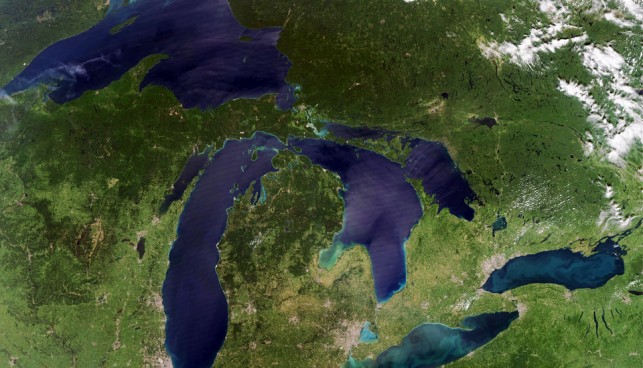
    Across the world North America is known for many things; the culture, the people and the great outdoors. Part of that great outdoors is the Great Lakes. The Great Lakes are an integral part of our North American identity; and to preserve that identity in 2005 the premiers of Ontario and Quebec and the leaders of eight American states that border the lakes came together and signed the Great Lakes Water Pact.

    The Great Lakes Water Pact is a pact that has introduced strict regulations in regards to the usage of the Great Lakes and it has sunk the tentative thoughts of shipping water to thirsty regions in the United States and Middle East. It was signed by the Canadian provinces and the American states that surround the Great Lakes; Ontario, Quebec, Ohio, New York, Pennsylvania, Michigan, Indiana, Illinois, Wisconsin and Minnesota. The agreement includes rules that make it difficult for communities surrounding the Great Lakes watershed to use the water and also aims to prohibit the commercial export of the lake water by restricting withdrawals of water to five gallon (twenty litres) containers.

    The affects this pact has on future generations are great. The Great Lakes are a natural resource that are depleting and are not renewing as fast or as much that is necessary. More than thirty five million people rely on the lakes for drinking water, and the lakes are only able to replace one percent of that per year.

    The Great Lakes Pact is important for North America’s future generation because it ensures that not all the lakes will be used up and it will be saved from disappearing. This works in the favour of future generations because it guarantees that the lakes will be there for their own usage as well just as it was there for the past generations usage. Not only does it assure fresh and natural drinking water for generations to come but it also promises that the amount of surface water in the world stays intact. The Great Lakes contains twenty percent of the world’s surface water and this pact will make sure that the surface water will remain for years to come. Without that surface water the world may dry up which in turn will not only affect people directly but also indirectly via the drying up of crops and vegetation.

    The Great Lakes Water Pact was signed in the year 2005 but its positive effects will last the world for years to come, both directly to people close to them and indirectly to people around the world. Directly through the fact that the Great Lakes are a source of fresh drinking water for people that surround them and indirectly because of the Great Lakes being a source of surface water that helps hydrate crops and vegetation, and without the lakes those crops and vegetation’s would dry up and therefore not feed communities around the world.

  • Incredible Eyes

    Incredible Eyes

    Did you know that tuna have a third eye? Or that shrimp can see colours we can’t even imagine? We humans rely so much on our eyesight that it’s hard to imagine there are things it can’t do. At least your eyes can help you read a few strange facts about vision in the animal kingdom.

    Three-Eyed Beasts!
    Though it’s hard to see, many fish, reptiles and amphibians have a third eye called the parietal eye. It’s smaller than the other two and often covered by a layer of skin. It usually appears as a small, grey oval between their other eyes. The parietal eye can’t see the same way other eyes do, but it has a small lens and retina that allows it to detect light and dark. It helps animals keep track of the time of day and regulate their body temperature.

    That Creepy Glow
    Everyone’s seen that creepy Halloween image of a black cat in the middle of the night, invisible except for its shining green eyes. Why do cats have that unsettling trait and we don’t? Actually, it’s not just cats. Lots of animals can do this, particularly ones that are active at night (nocturnal). This includes horses, cows, dogs and hyenas. These animals have a layer at the back of their eye called the tapetum lucidum. When light shines at them from a bright source, they reflect it back like a mirror. This helps them see in the darkness.

    Seeing Heat
    Infrared vision – the ability to see heat – is something we think of superheroes having. Well, snakes have it, too! Pitvipers, as well as some boas and pythons, can all see heat. This actually has nothing to do with their eyes, but it’s still a sort of vision. It takes place in a “pit organ” between the eyes and the mouth, which functions differently in different kinds of snakes. Since many snakes have poor vision, this helps them to find warm-blooded prey. It’s so powerful that it even allows a blind rattlesnake to strike at the vital organs of its prey. Scientists have recently discovered that this pit organ is not just for hunting, it’s also a survival tool. The snakes that have it are better at finding a place to warm themselves up than other snakes who don’t.

    Expanding the Rainbow
    We have something in our eyes called cones that allow us to see colours. Our eyes have three cones: red, green and blue. By combining them, we see all the colours that we think of in a rainbow. But we’re missing out. Some other animals have far more cones than we do. The mantis shrimp takes the prize, with sixteen cones in their eyes! This means they see colours that we can’t even dream of. Scientists have also speculated that some women have a fourth yellow cone that allows them to see more variations in colour than the rest of us. So maybe you or your sister is privileged with seeing a wider rainbow than the rest of us.

    It’s easy to think of us humans as being the most evolved species on the planet. Sometimes we forget that even a cow sees things in a way that we can’t!