Category: Featured Articles

  • Meal Prepping Tips For Busy Professionals

    Meal Prepping Tips For Busy Professionals

    People’s professions can often keep them very busy. Due to how busy they are, other important tasks that relate to their well-being, like preparing meals, aren’t always prioritized. The lack of prioritization may then lead to other means, including eating takeout more often than they’d like or making subpar home-cooked food, both of which make for unsatisfying dining experiences. If this sounds like what you’ve been thinking about lately and you’re a busy professional who wants to have better meals via improved prepping strategies, here are some tips:

    Look Up Quick And Easy Recipes

    There are a lot of quick and simple recipes that taste very good as well. Great places to find some include websites such as allrecipes.com, or you could look up cookbooks by reputable chefs. Are there any specific dishes that you’ve been craving? Would you like to see if there are easy-to-make versions of them? Overall, you’ll likely find many options if you do this research.

    Consider Purchasing and Cutting Up Versatile Vegetables

    Certain vegetables are used in many different dishes. For instance, people put mushrooms in salads, omelets, burgers, pasta, on pizza and more. They’re also delicious when sautéed or eaten raw on their own. If you cut up these vegetables all at one time, then you’ll have them immediately ready to use for the next few days. A good idea would be spending either a Saturday, Sunday, or any day you have time to do this.

    Cutting might seem like a monotonous activity, so you can make it more enjoyable by listening to your favourite music, audiobook, podcast, etc. while doing so. You can also think of this as a relaxing break from work.

    Freeze Food To Eat Throughout The Week

    While it’s (of course) ideal to always have fresh, nutritious meals, sometimes this can’t happen, especially for busy professionals. Thus, another idea would be, relatively similar to what’s stated above regarding vegetables, making about a week’s worth of meals one day, but then further dividing them into their appropriate portions, freezing the food, then taking these portions out to defrost throughout the week or whenever you see fit. The freezing strategy is especially convenient for dinners. As a result, there are no worries about what to eat when you get home/finish work. Casseroles are good to make for this option.

    It’s additionally advised to ensure that the food is stored properly, should you plan on freezing it (if you don’t know how to already), as proper storage would prevent premature freezer burn. For example, would solely using a re-closable bag suffice? Or do you need other supplies to cover it, such as plastic wrap or aluminum foil?

    All in all, balancing various responsibilities when you’re a busy professional can definitely be difficult. Nonetheless, carving out the time to prioritize other areas of your life, even when regarding seemingly menial tasks like meal preparation, is beneficial. For many, having good home-cooked meals contributes to more quality moments in everyday life. The pieces of advice above, including finding easy recipes, buying and cutting versatile vegetables, and freezing, are meant to make prepping experiences more efficient as well as take the stress out of deciding what to eat. If you consider meal preparation a priority and want to try better ways to go about it, following these tips is a step in the right direction.


  • Getting Dirty May Be Healthy (French version available)

    Getting Dirty May Be Healthy (French version available)

    For much of human history, we lived close to the natural world. As civilization evolved, we became increasingly urbanized, and most of us now live in cities. As we’ve moved away from nature, we’ve seen a decline in other forms of life. Biodiversity is disappearing. The current rate of loss is perhaps as high as 10,000 times the natural rate. The International Union for Conservation of Nature’s 2008 Red List of Threatened Species shows that 16,928 plant and animal species are threatened with extinction. This includes a quarter of all mammal species, a third of amphibian species and an eighth of bird species. And that’s only among those we know about; scientists say we may have identified just 10 to 15 per cent of existing species.

    It can be a challenge to communicate why this loss is important. We know species diversity is critical to the healthy functioning of ecosystems that provide services on which humans depend. But could we live with fewer? Some would argue we could do without mosquitoes and other annoying critters. We could keep the ones we want and those that are useful to us. Do we need biodiversity to keep humans healthy?

    According to an article in Conservation magazine, there is a link between biodiversity and human health. Ilkka Hanski and his colleagues at the University of Helsinki compared allergies of adolescents living in houses surrounded by biodiverse natural areas to those living in landscapes of lawns and concrete. They found people surrounded by a greater diversity of life were themselves covered with a wider range of different kinds of microbes than those in less diverse surroundings. They were also less likely to exhibit allergies.

    What’s going on? Discussion of the relationship between biodiversity and human health is not new. Many have theorized that our disconnection from nature is leading to a myriad of ailments. Richard Louv, author of Last Child in the Woods, says people who spend too little time outdoors experience a range of behavioural problems, which he calls “nature deficit disorder”. It fits with theories of modern ecology, which show systems lacking in biodiversity are less resilient, whether they’re forests or microbial communities in our stomachs or on our skin. Less resilient systems are more subject to invasion by pathogens or invasive species.

    Hanski studied a region in Finland where few people move far. He randomly selected 118 adolescents in an equal number of homes. Some were in the city, and others were in the woods or on farms. The team collected skin swabs from subjects and then measured the biodiversity of plants around each house. Their data revealed a clear pattern: higher native-plant diversity appeared to be associated with altered microbial composition on the participants’ skin, which led in turn to lower risk of allergies.

    Hanski and his colleagues found that one group of microbes, gammaproteobacteria, appears to be associated both with plant diversity and allergies. And it didn’t matter whether they considered allergies to cats, dogs, horses, birch pollen or timothy grass. People with more diverse kinds of gammaproteobacteria on their bodies were less likely to have allergies.

    The immune system’s primary role is to distinguish deadly species from beneficial and beneficial from simply innocent. To work effectively, our immune system needs to be “primed” by exposure to a diverse range of organisms at an early age. In this way, it learns to distinguish between good, bad and harmless. If not exposed to a wide array of species, it may mistakenly see a harmless pollen grain as something dangerous and trigger an allergic reaction. We also know that bacteria and fungi compete. Fungi are often associated with allergies, and it could be that the high diversity of bacteria keeps the fungi in check.

    A conclusive explanation for Hanski’s observations is not yet available. More research is needed. But we know we evolved in a world full of diverse species and now inhabit one where human activity is altering and destroying an increasing number of plants, animals and habitats. We need to support conservation of natural areas and the diverse forms of life they contain, plant a variety of species in our yards, avoid antibacterial cleaning products and go outside in nature and get dirty — especially kids. Our lives and immune systems will be richer for it.

  • Signs a Career in the Trades May Be for You

    Signs a Career in the Trades May Be for You

    A career in the trades is a phenomenal opportunity to work in an engaging, hands-on environment. But how do you know this kind of career is right for you? If you’re thinking at all about going into a trade, there are certain core skills, assets, and traits common to many tradespeople that may encourage you to look deeper into this kind of opportunity. Here are four signs suggesting that a career in the trades may be right for you.

    You like figuring out how things work.

    Some people are fascinated by the intricacies of machinery or equipment, and have a knack for seeing how the pieces of complicated mechanical puzzles fit together. If you’ve ever taken apart a toy or electronic just to get a glimpse of how it works, you would probably enjoy trades that involve these types of activities, such as mechanics or construction. Due to the experiential nature of the field, a career in the trades will help you gain a more comprehensive understanding of systems and processes.

    You like to solve problems.
    Problem-solving lies at the core of many trades. Whether you are repairing something that needs fixing, implementing upgrades that will help something work better, or creating something new that will facilitate the functioning of a device or machine, careers in the trades will certainly allow you to develop the skills necessary to find a solution to even the most complex problems. The consultation and evaluation process involved in many trades will allow you to tackle problems in an innovative way, and there is excellent satisfaction in knowing that you contributed to the resolution when a problem is finally solved.

    You learn best hands-on.
    Most people have a preferred method that they know helps them most effectively learn new information and skills most effectively. If you learn best from direct experience and action, as opposed to readings or lectures, the trades might suit your needs. Most trades careers allow you to work with your hands, performing tasks such as assembly, building, or repairs, and broadening your learning in an experiential way. As such, these careers are often great for people who like to stay active and prefer concrete, experiential learning over more abstract theories and methods.

    You want to stay active on the job.

    Being cooped up in an office or sitting behind a desk all day doesn’t bode well for all employees, especially if you are used to working on your feet. Luckily, the physical activity associated with many trades allows you to expend your energy in a more active and engaging way. Some careers in the trades can also involve travelling and fieldwork in different locations, which is great if you thrive when exposed to different work environments.

  • Your post-secondary goals may change, and that is okay. (French version available)

    Your post-secondary goals may change, and that is okay. (French version available)

    I wanted to be an accountant. I figured I’d complete my mandatory year of prerequisite arts at the University of Alberta, transfer to the Faculty of Business, and major in accounting. I’m now a writer. So what happened?

    During my first semester, I found myself enthralled with my writing-focused English courses instead of the Business calculus, statistics, and economics prerequisites. I spent hours perfecting my essays, and my professors encouraged me to pursue the arts. I always enjoyed writing; however, I never considered it as something that I could monetize. I went on to work at my University’s writing center, instruct introductory English courses, and get a job writing marketing content for local businesses.

    As a disclaimer, there is nothing wrong with sticking to your original plan; dedication is a wonderful trait to possess. If you’re sure of what you want and how to get it, then you should be proud. However, if while studying you stumble upon something better suited to your aptitude and passions, shouldn’t you reaccess your original goal and make sure you will still feel fulfilled when you, after the hard work, reach it?

    I frequently encounter people who, while in University, were exposed to a career path that they regret not following. Among them are engineers who wanted to be teachers, scientists who wanted to go into marketing, pharmacists who wanted to be nurses, and the list goes on.

    Their reasons for not pursuing these alternate goals are varied, but they often focus on “even though I would have rather done y, I already put so much effort into x” – this is called the sunk cost fallacy and sometimes makes us act silly.

    I fell victim just last week: I was watching a series on Netflix, and halfway through, I determined that I didn’t like it. Instead of choosing something else, I told myself, “I’ve already watched half of this, so I might as well finish.” I knew that I had already wasted hours of my life on this series, yet I used that poor investment as a reason to continue watching. I’m sure if you reflect on some of your decisions, you can catch yourself doing this, too!

    Sticking to your goals is paramount to success, but make sure your goals are evolving with you. If you find yourself bored or depressed from dedicating your time to studying something you no longer enjoy, you may benefit from reconsidering your options. Of course, following your heart may not always be viable, and there are reasons to stick with an imperfect situation, such as financial limitations. However, if you see a viable, more fulfilling, alternate plan, remember that the time, money, and other resources you invested into your original goal are in themselves not a logical reason to continue something you no longer want. It’d be a shame to work hard at studying a discipline you are no longer passionate about just to get a job dealing with more of the same!

  • Sticks and Stones May Break My Bones…But Names Can Still Hurt Me.

    Sticks and Stones May Break My Bones…But Names Can Still Hurt Me.

    We’ve all heard the saying, “sticks and stones may break my bones, but names will never hurt me,” right? Well, what if I told you that saying might have some work to do when it comes to considering people’s feelings? Name-calling does hurt, and it is just one of many ways you could hurt someone’s feelings and not even know it. Let’s talk about some ways we can recognize we might have hurt someone’s feelings, and how we can make it right.

    How can I keep myself from hurting someone’s feelings in the first place?

    One of the best ways to keep yourself from hurting your friend’s feelings is to stop and think to yourself, “Would I like it if someone said this to me?” If the answer is no, then stop right there! If it would hurt your feelings, it will hurt someone else’s, too. If it’s not something you’d want someone to say to you, then don’t say it. A good way to think about it is to treat everyone the way you want to be treated.

    How do I know if I have hurt someone’s feelings?

    Sometimes, our friends will be very clear and tell us when we have hurt their feelings, but sometimes things can be a little bit trickier than that. Let’s look at some warning signs that you may have caused harm to someone’s feelings.

    • They look sad or mad after you said something.
    • They suddenly become very quiet or stop talking after a comment you made.
    • You notice a change in the way they are speaking. They may have become very short with you or seem irritated.
    • Someone tells you, “That wasn’t a very nice thing to say.”
    • You feel bad about something you said.
    • They walk/run away.
    • You said something you wouldn’t like if someone said it to you.
    • They no longer want to talk to you.
    • If it was over the phone, they stop replying to your messages or end the phone call.
    • They seem distant from you, or you get a sense that things are a little “off” between you two.

    Okay, I think I might have hurt someone’s feelings. How can I make things better?

    Everyone makes mistakes, so it’s important to remember that just because you made a mistake, it doesn’t mean you are a bad person. Making things right after hurting someone’s feelings and making sure you don’t make that same mistake again are important parts of growing up. So, what steps can you take when you’ve hurt someone’s feelings?

    • If you’ve hurt someone’s feelings, the best way to make things right again is to apologize. Apologizing shows you now understand that what you said/did was wrong, and it wasn’t something you should have said or done. Although you can’t change what you did, you are now taking the right steps to make things better for the person you hurt.
    • Make sure your apology is sincere. If you don’t mean it when you say, “I’m sorry,” you won’t be making anything better. A good apology is one that comes from the heart, and should be a shorter way of saying, “what I did was wrong. I wish I didn’t make you feel this way, and I won’t do it again.”
    • Remember, it’s important to learn from your mistakes. Make sure when you tell your friend you aren’t going to make this same mistake again, it’s the truth. Changing your behaviour when you’ve hurt someone is a great way to show you’re truly sorry.
    • Forgive yourself. Remember, it was a mistake, and we all make mistakes. What’s important is that you learn from what you did, make the right changes so it doesn’t happen again, and let yourself move on.

    Sources:

    http://kidshealth.org/en/teens/apologize.html

    http://www.answers.com/Q/How_can_you_tell_when_you_have_hurt_someone’s_feelings?#slide=7

  • Are you saying what you think you’re saying? The messages you may be giving off with body language.

    Are you saying what you think you’re saying? The messages you may be giving off with body language.

    You may think of yourself as a confident and friendly person, and anyone who really knows you might say the same. However, if you’re slouching, avoiding eye contact, and looking down, someone who is meeting you for the first time may perceive you in a completely different way. This is the power of body language. By now, you may be thinking, so what? Is body language really that important? The answer: absolutely! Most of what human communication is nonverbal. This means people who are meeting you for the first time, such as potential employers, may get an impression of you before you even have a chance to speak. The question is, is your body language giving off the impression you want? Let’s take a look at some of the key aspects of body language and talk about whether it may be time to adjust what your body is saying about you.

    Negative Body Language: Some signs you may not be putting your best foot forward.

    1. Avoiding eye contact.

    Making direct eye contact may feel a little scary, but it’s extremely important. A lack of eye contact gives off the impression of nervousness, a lack of confidence, and even dishonesty. Eye contact is especially important during an interview with potential employers, as confidence and honesty are some of the main points employers look for!

    1. Slouching.

    Poor posture results in poor body language! Slouching tells people you may be lacking in confidence, or are uninterested/bored in what’s going on. Although slouching is something many of us do without realizing it, it’s important to make a conscious effort to sit up straight, especially when trying to give off a good impression.

    1. Crossed arms.

    You may not be aware, but crossing your arms creates an invisible barrier between you and the person you’re speaking with. This sends the message that you are closed off or unwelcoming. Avoid this kind of negative body talk by keeping your hands to one side or on the other hand. This will indicate friendliness and openness.

    1.  Checking your phone or watch.

    While you may just be checking the time, you may be giving off the impression that you’re bored, anxious, or too busy thinking about what’s going on next to really focus on the person you’re speaking with. Break this habit by refraining from checking your watch during interviews, and make sure your cell phone is turned off and put away.

    For more signs of negative body language, check out this link.

    Positive Body Language: Ways you can give off the right impression for success.

    1. Give a firm (non-crushing) handshake.

    Handshakes are one of the most important forms of communication during a first impression. It sets the tone for the rest of the conversation and reveals confidence. Just be sure not to crush or pull someone’s hand, as this may reveal bullying or an attempt at intimidation.

    1. Slow down your speech.

    Interviews can be nerve-wracking, and your speech may speed up without you even knowing. Take a big, deep breath and slowly let it all out. Focus on slowing down your speech. It will calm you down and give off a stronger sense of confidence.

    1.  Give affirming movements.

    Nodding your head or smiling are affirming actions that show you’re engaged in the conversation, and you understand what is being said. Just be sure not to nod too frequently, as this may reveal a lack of confidence.

    1. Lean.

    This one may be unfamiliar to most people, but leaning in slightly when someone talks reveals active listening skills and shows engagement and interest in the conversation. On the flip side, leaning away gives off the opposite impression. Leaning away from the speaker reveals hostility or a lack of interest.

    For more positive body language tips, check out this link!

    The right body language may be hard at first, but just remember to be alert and aware of your actions. With practice, you’ll be revealing the incredible person you are the moment you walk in the room!

    Sources Used:

    https://blog.udemy.com

    http://study.com

  • 5 Careers You May Not Realize are Skilled Trades

    5 Careers You May Not Realize are Skilled Trades

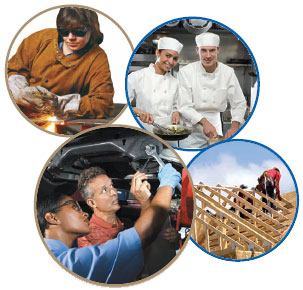
    While it’s true that when most people think of “the trades,” the first things to come to mind are jobs like metalworking, electricians, millwrights and plumbers.  But physical careers like these aren’t the only option for students thinking of pursuing a career in the skilled trades.  Not every trade requires working with large tools, performing heavy lifting or high levels of physical activity.

    Service trades are also skilled trades, but can be less physically demanding. They require similar levels of education and work experience, such as college courses, co-ops and apprenticeships, and offer lots of opportunities to advance and build a strong, life-long career.

    Chef

    Chefs in the food service industry are skilled tradespeople, and they have the education and work experience to back this up. They can work in restaurants, hotels, hospitals, schools and many other places, and are responsible for overseeing food preparation, creating menus, catering events, hiring and managing kitchen staff, and purchasing kitchen equipment. Becoming a chef requires a combination of college education, apprenticeships and work experience, culminating in the Red Seal exam for certification to work anywhere in Canada.

    Bakers

    Another skilled service trade in the food industry, bakers work in bakeries, catering companies, hotels, hospitals and other institutions that serve food.  Bakers are also often self-employed and run their own bakery or baking services business.   They prepare baked goods including pies, breads, rolls, muffins, cakes and cookies, and often experiment to create new recipes.  Red Seal certification is also available to bakers who complete the required experience hours and examination.

    Barbers and Hairstylists

    The neighbourhood hairstylist and barber are obviously skilled, but not everyone realizes that this profession falls under the trades.  But like other trades, hairdressers and barbers are required to complete a college program, as well as an apprenticeship. There is a Red Seal certification available to hairdressers and barbers as well.

    Child and Youth Worker

    Another career that doesn’t immediately look like a skilled trade is that of being a child or youth worker.  These service workers work with young children and youths in order to improve their social, emotional, intellectual and physical development.  A college program is usually required, as this career covers a wide range of skills from nutrition and diet management, assessing the progress of a child’s development, assisting with learning, including reading, writing and math, assisting children with disabilities and more.

    Horticulture and Landscape Technician

    These tradespeople are responsible for beautifying outdoor spaces for both private homes and public areas.  Horticulture technicians will study and cultivate plants for use in landscaping and will provide treatment to sick or damaged plants.  Landscape technicians will design and plan landscape projects, oversee the planting and maintenance of trees and other plants, and advise on solutions for irrigation and land use.  This career features a lot of self-employment by owning and operating their own business, but these professionals can also work for golf courses, landscaping companies, greenhouses and national parks.

    SOURCES:

    https://www.jobbank.gc.ca/

  • Three Great Careers You May Not Realize Are Trades

    Three Great Careers You May Not Realize Are Trades

    What do you think of when you see the phrase “skilled trades?”

    Many people’s thoughts will go straight to a few of the most recognizable trades, such as electricians, carpenters, mechanics, or plumbers.  But there are actually many different jobs you see every day that are considered skilled trades, but which may not be obvious at first glance.  This means that even if you aren’t interested in working a job related to construction, there are lots of other exciting and profitable careers to choose from that still fall under the category of skilled trades.

    Hairstylists and Makeup Artists

    If you’re interested in fashion trends and using your artistic skills on other people, then developing a career as a hairstylist or makeup artist is a great way to go. Considered a service trade, these jobs require a keen eye for detail, steady hands to wield a makeup brush or stylists’ scissors, and a desire to help people feel great about themselves by giving them a great look.

    Hairstylists will often work in a salon, taking regular appointments, but both hairstylists and makeup artists can also work independently in their own business.  Often, these tradespeople will choose to specialize their business toward a specific type of work, such as wedding hairstyles and makeup.  They can also be employed freelance or with a studio doing hair and makeup for movies and television.  Most hairstylists and makeup artists take a combination of college or beautician trade school courses, as well as working apprenticeships, to learn the skills they need.

    Chef

    Do you have a love of food, cooking, and creating new recipes to share with friends and family?  Working as a chef is a perfect career for someone who loves learning new things about the food we eat, and making others happy and healthy by cooking them great meals.

    Chefs are skilled tradespeople who work in kitchens, restaurants, event venues, cafeterias, hospitals, and many other places where meals are required to be prepared and served.  They can be employed by these places directly, or chefs can establish themselves as independent catering businesses and hire on for specific events.  Many trade schools and colleges offer culinary programs designed to train chefs, but you can also start directly in a kitchen as an apprentice to learn the ins and outs of this trades career.

    Dental Hygienist

    Working as a dental hygienist is a great career choice for those who are interested in the medical field, but who may not want to become a doctor or nurse.  These skilled tradespeople perform the initial part of a standard dentist’s visit, including cleaning a patient’s teeth, examining their gums, administering fluoride or mouthwashes, and assessing a person’s overall oral health.  They work alongside dentists and medical receptionists to manage patient information, and must have excellent interpersonal skills to work smoothly with both coworkers and the patients they are examining.

    Dental hygienists typically complete a college degree to learn the necessary medical and dental background and develop their hands-on skills.  There will also be training and other practical practice before working on an actual person.

    And Many More!

    Of course, these are only three examples out of dozens of skilled trades.  However, these three very different trades demonstrate the breadth of trade careers available.  Whatever your interests–whether you want to do something artistic and creative, something that nurtures other people, or something related to healthcare and the wellbeing of others–there’s a trades career out there for you!

  • Getting Your Hands Dirty May Be Your Proudest Moment

    Getting Your Hands Dirty May Be Your Proudest Moment

    Much has been said about the trades industry and how it’s an industry that solely relies on physical strength. However, if there’s anything that the pandemic made us realize is that those who work in the trades are essential workers and are the ones who work the hardest, making them valuable in any community. Without them, we would not have been able to survive the challenges brought about by the virus that affected all of us on a global scale.

    These Jobs Are Essential

    One of those who rally behind opposing the general idea that the trades industry is something to frown at is Mike Rowe, the star of the show “Dirty Jobs” on the Discovery Network. Rowe is extremely dedicated to the cause that he launched his own nonprofit organization that promotes training for skilled trades, like welders, plumbers, pipefitters, carpenters, and auto repair technicians.

    So far, the organization has awarded $5 million in scholarships over the last 12 years. Rowe was inspired by his grandfather, who, although he finished only seventh grade, was already a master electrician by the age of 30. Rowe strongly believes that people should do away with the notion that only those with four-year degrees can lead to jobs with six-figure annual salaries. In addition, some of the famous billionaires today weren’t able to earn their degrees, including Michael Dell and Bill Gates, as well as the late Steve Jobs. As they say, for every rule, there is an exception.

    It’s Not Just a Man’s World Anymore

    Skilled trades in Canada are currently under a shortage of qualified workers as the younger generation continues to be lured into jobs that provide them with the convenience of being able to work from the comfort of their own homes. It has especially gotten more difficult to convince college- or university-bound students to carve their career path in skilled trades instead.

    With this labour shortage in the skilled trades, BuildForce Canada reports that Ontario, in particular, will need to hire 103,900 in the construction and maintenance industries over the next decade as the Ontario government predicts that one in five new jobs in the province over the next five years is expected to be in the trades.

    There’s no easy way to fill in the gaps, but embracing the idea that women can also be instrumental in answering the labour shortage in the skilled trades industry is a good start. After all, the misconception that trades are merely for men is as outdated as fax machines. And there are various organizations who are determined to break down these barriers, including the recently launched Women in Steel Toes or WIST. WIST has its own website and Facebook page where women share their experiences working in the trades, particularly in construction. They intend to inspire the younger female generation to consider career paths in the skilled trades, where they will have a plethora of options, something that wasn’t promoted before.

    The Women in Skilled Trades and Information Technology Training programs are also determined to further the cause of inspiring women to get into skilled trades. They provide free training for small groups of women in specific trades at various colleges throughout Ontario. The provincial government is a huge supporter of this, and one program, announced last fall, hopes to fund 24 women to receive training as horticultural technicians or arborists at Humber College. The federal government is not far behind with backing the idea, as it also provided funding for a countrywide roll-out of an outreach for teen girls.

    Brain Power

    With the false impressions about the skilled trades industry slowly dissipating as the case should be, it’s interesting to note that these fallacies have little basis in the first place.

    For example, working in construction is no mean feat, and it’s not merely about physical strength or endurance. A construction worker has to be an excellent problem solver, or how else can you erect a building from nothing at all?

    Other skilled trades work like plumbing and electrical require an impeccable sense of attention to detail; otherwise, all homeowners will see are flooded bathrooms and faulty electrical wiring.

    Skilled trades require mental prowess and physical dexterity, and those who are up for a challenge can truly feel at home in this career path.

    SOURCES:

    https://www.equipmentjournal.com/on-the-job/women-in-steel-toes-aims-to-normalize-women-on-jobsites/

    https://www.tvo.org/article/you-wouldnt-be-interested-in-that-fighting-stereotypes-about-women-in-the-trades

    https://www.startribune.com/dirty-jobs-host-will-make-the-case-for-hands-on-work-at-home-garden-show/568081402/

    https://www.leaderonomics.com/articles/leadership/why-it-pays-to-get-your-hands-dirty

  • How Appearance May Affect Job Interview Results

    How Appearance May Affect Job Interview Results

    You received an offer for an interview, and now you wait in anticipation. What do you wear? What do you say? How do you display that you are the right candidate for the job?

    Ideally, you would love to be hired purely on your qualifications. Unfortunately, sometimes the moment that you step in front of the interviewer, the decision has already been made — for a reason that has nothing to do with your skills.

    As much as it may be hard to admit, appearance plays a factor in the hiring process, leaving applicants with limited options to showcase their skills.

    What is Appearance Discrimination?

    Everyone has biases, regardless of whether they are aware of them or not. It is a natural way human brains categorize items. While it is impossible to be completely free of biases in decisions, being more aware of those influences can be helpful.

    Appearance discrimination is the different treatment of people based on how they look. “Appearance” is a broad term that encompasses multiple categories of the way people look. Attributes like height, weight, hair colour, hair style, clothes, and makeup combine to make a person’s image.

    Even with a list of qualifications, people assume ideas about others from an initial meeting. Appearance plays a factor in those first impressions. The reality may differ from a person’s first perception, but no doubt, first impressions are powerful.

    Does Appearance Discrimination Exist?

    In a 2017 study conducted by the Saint Louis University School of Law, results showed that workers and applicants were often evaluated based on how much their appearance matched the presumed ideal for masculine or feminine individuals. Their images had more weight to their perceived worth as an employee than the words etched on their resumes.

    Additionally, according to the Ontario Human Rights Commission, height and weight specifications are aspects that are evaluated in areas that are traditionally male-dominated. However, these qualifications are based on the qualities of men who belong to the majority group in Ontario.

    This leaves people, such as women or people of colour, incapable of reaching such qualifications. For example, people of Asian descent are, on average, smaller in stature than the majority group of Ontario’s population.

    Appearance Discrimination and Law

    Both B.C. and Ontario’s Human Rights Codes do not label it illegal for employers to make conclusions based on appearance. However, in some cases, doing so may infringe on a person’s rights.

    Actions such as requiring applicants to attach a photo to their resume expose employers and applicants to potential legal trouble. For example, if a Sikh applicant was denied a job because he wore a turban, an employer can be liable. That action is not acceptable.

    In contrast, it is acceptable to require the disclosure of applicants’ personal information if it is relevant to the job. However, such circumstances are very minimal. As such, specifications like one’s weight and height are not considered bona fide, or legitimate, qualities to demand.

    Reducing Appearance Discrimination

    Admitting that this bias exists is the most important step to reducing appearance discrimination. Without acknowledgement of the bias, steps to solve it cannot be taken.

    In the hiring process, employers have the most power to reduce appearance discrimination. While applicants themselves have limited options to reduce this bias, they can start with submitting resumes without photos. Photos are scarcely a legitimate requirement for jobs, making them unapplicable to most job listings.

    Employers’ hiring tools may also help reduce appearance discrimination through technology: LinkedIn has a “hide names and photos” feature, and there are many other platforms that will make resumes anonymous. Employers should evaluate every applicant with the same list of requirements to keep the process fair. In addition, employers would benefit from diversifying their hiring teams to ensure lessened levels of discrimination.


    Sources:

    “9. The Duty to Accommodate.” Ontario Human Rights Commission, https://www.ohrc.on.ca/en/policy-preventing-discrimination-based-creed/9-duty-accommodate.

    Blair, Jonathan. “Equality in Hiring – When Are Interview Questions Discriminatory?” BC Human Rights Clinic, 24 Oct. 2018, https://bchrc.net/equality-in-hiring-when-are-interview-questions-discriminatory/.

    Hilgers, Laura. “5 Ways to Reduce Bias When Screening Candidates — and Find More Talent.” Talent Solutions Blog, LinkedIn, 19 Oct. 2021, https://www.linkedin.com/business/talent/blog/talent-acquisition/ways-to-reduce-bias-when-screening-candidates.

    Indeed Editorial Team. “FAQ: Should I Include a Photo on My Resume? (With Tips).” Indeed Career Guide, 31 Aug. 2021, https://ca.indeed.com/career-advice/resumes-cover-letters/photo-on-resume.

    Jones, Jeff. “APPEARANCE DISCRIMINATION: IS IT ILLEGAL?” UCBJ – Upper Cumberland Business Journal, https://www.ucbjournal.com/appearance-discrimination-is-it-illegal/.

    Pavlou, Christina. “Unconscious Bias in Recruitment: How Can You Remove It?” Recruiting Resources: How to Recruit and Hire Better – Workable, https://resources.workable.com/stories-and-insights/unconscious-bias-in-recruitment.