
Category: Featured Articles

  • How You Can Help the Environment Right Away

    How You Can Help the Environment Right Away

    Climate change is the biggest problem we face in the 21st century. There is a lot of news about the effect it will have on the planet in the near future, and much of it is terrifying. This is the time for everyone, you included, to take action. Some of us can take bigger steps than others, but the worst thing we can do is nothing. The sooner we take that first step, the better the next century will be. There is a lot you can do right now that will inspire yourself and others to keep working toward a better future.

    Our individual journeys start with ourselves. What comes to mind when you hear the words “environment” or “climate?” Write down everything that comes to you. This will give you an idea of what is important to you and where you can start. There are steps you can take in your day-to-day life. Try eating less meat, especially beef, as the industry adds a lot of carbon to the atmosphere. Instead of just recycling, try “precycling,” which is when you make sure there will be less garbage before you get something. Bring your own bag to the store instead of using plastic bags. Buy the smaller item or one that has less packaging.

    The next step in your journey is to look at the people and places around you. Encourage your family to think more about how their actions impact the environment. Remember that you are not judging each other but trying to help one another make the world better. Your school is a big opportunity to spread great ideas and make things happen. Talk to your friends and teachers and ask for their ideas as well. Your next classroom project or presentation could be on the environment. Parents can be encouraged to leave the car at home and walk their children to school each morning. Many schools have started tree-planting projects and gardens that help students learn more about nature and why it is important.

    If there are no nature or environmental clubs at your school, start one yourself! You can get teachers and staff to help you with school-wide activities and presentations at assemblies or community events. As a group of students, you can start campaigns that will help the environment and community through organizations such as DoSomething.org or IMatterYouth.org. As your journey continues and grows, you can set your sights on larger goals. This might include contacting government officials or starting up a larger group in your city using a community centre. What started as some ideas written down on paper can turn into something much bigger and make a grand impact.

    Threats to the environment are great and growing, and sometimes, it can be very difficult to hear the latest news on environmental destruction or climate change. This is why it is more important than ever for all of us, no matter your age, to take action. The smallest of steps can grow into the biggest of changes. One person alone is not enough to make the difference needed. But as more and more individuals take those steps, the brighter the future will be for everyone.

    Sources:

    Gienapp, Rebekah. “9 Ways Kids Can Protect the Planet, on Earth Day and Every Day.” The Barefoot Mommy. http://www.thebarefootmommy.com/2017/04/earth-day-for-kids/

    The Guardian. “How to make your school more eco-friendly.” https://www.theguardian.com/environment/2010/feb/12/carbonfootprints-carbon-emissions

    We Have Kids. “26 Ways Kids Can Protect the Environment!” https://wehavekids.com/parenting/26-ways-your-kids-can-help-protect-the-environment

  • What’s an Apprenticeship?

    What’s an Apprenticeship?

    Apprenticeship is a form of post-secondary training that teaches the skills and competencies necessary to perform tasks to an industry standard. Apprenticeship training provides the opportunity for hands-on learning under the direction of a certified journeyperson, with the ability to earn while you learn. The training combines alternating periods of on-the-job (80 to 85%) and technical training (15 to 20%). Technical training can occur at a college, a union training centre, a private trainer or online. Once the apprentice has completed the required hours and/or modules for the trade, the apprentice can write a certification exam. Apprenticeship is regulated by the provinces and territories, creating 13 unique systems geared to the labour market needs and conditions in each region of Canada.

    Canada also has a standard of excellence known as the Interprovincial Standards Red Seal Program. It is offered in 55 trades. Through the Program, tradespersons obtain an endorsement on their provincial/territorial certificates by successfully completing an interprovincial exam, making it easier for them to move between provinces or territories and employers.

    How long does it take to complete an apprenticeship program and become a certified tradesperson?
    The length of the training varies depending on the trade, but generally takes between 2 and 5 years. Most of the training is provided in the workplace. Normally, an apprentice works for 40 to 44 weeks a year and goes to school for a six-to-eight week “block” of training.

    How much does it cost to complete an apprenticeship?
    Apprenticeships cost very little compared to most post-secondary training options. Tuition costs vary depending on the trade and the province/territory. There may be additional costs for books, equipment, tools and living expenses. However, apprentices are paid during their on-the-job training. There are also a number of grants and tax credits available to reduce the cost of apprenticeship training. Consult your local apprenticeship office to learn more about both federal and provincial/territorial supports.

    Another big benefit of apprenticeship training is that it allows apprentices to “earn while they learn,” significantly reducing student debt loads. University undergraduates left school with an average debt load of $25,000 in 2005, with much higher rates of debt in the eastern provinces. As paid employees, apprentices are generally able to cover their costs without substantial student debt.

    Does an apprentice receive an income while attending a technical school?
    If apprentices have been employed for long enough to qualify, most are eligible for Employment Insurance (EI) while they are in school. Some employers pay their apprentices while they’re in school or “top up” EI benefits so apprentices continue to receive the equivalent of their wages while they’re in school. It is recommended that apprentices have this discussion with their employers upfront. Apprentices serve only one two-week waiting period per apprenticeship and are not generally required to wait in subsequent training periods. It is important to understand the regulations surrounding Employment Insurance eligibility, so be sure to contact Service Canada for more information.

    Are apprenticeships regulated by the government?
    Apprenticeship programs are regulated by provincial and territorial governments. Each province and territory is responsible for deciding whether a trade is designated “compulsory” or “voluntary.” If a trade is compulsory, legislation generally requires someone working in that trade to be a qualified journeyperson or an apprentice working under the supervision of a journeyperson. This typically comes into play in areas involving public safety (i.e. an electrician). Check with your provincial/territorial apprenticeship authority to learn more about designated trades in your jurisdiction.

  • What is Acid Rain?

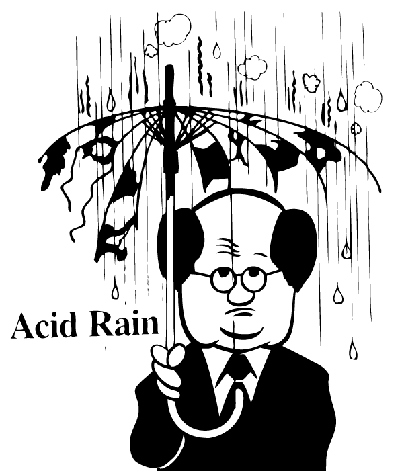
    What is Acid Rain?

    The term acid rain refers to what scientists call acid deposition.  It is caused by airborne acidic pollutants and has highly destructive results.

    Scientists first discovered acid rain in 1852, when the English chemist Robert Agnus invented the term.  From then until now, acid rain has been an issue of intense debate among scientists and policy makers.

    Acid rain, one of the most important environmental problems of all, cannot be seen.  The invisible gases that cause acid rain usually come from automobiles or coal-burning power plants.

    Causes

    For many years, there was considerable debate and disagreement over what caused acid rain.  Recent scientific work, however, has helped to clarify this.

    The primary causes of acid rain are sulfur dioxide and nitrogen oxides.  These chemicals are released by certain industrial processes, and as a result, the more industrialized nations of Europe as well as the US suffer severely from acid rain.

    Most sulfur dioxide comes from power plants that use coal as their fuel.  These plants emit 100 million tons of sulfur dioxide, 70% of that in the world.

    Automobiles produce about half of the world’s nitrogen oxide.  As the number of automobiles in use increases, so does the amount of acid rain.  Power plants that burn fossil fuels also contribute significantly to nitrogen oxide eemissions

    Though human causes are primarily responsible for acid rain, natural causes exist as well.  Fires, volcanic eruptions, bacterial decomposition, and lightning also greatly increase the amount of nitrogen oxide on the planet.  However, even the gigantic explosion of Mt. Helens released only about what one coal power plant emits in a year.

    Once the tiny pollutant molecules have entered the atmosphere, they can travel for thousands of miles.  Eventually, the particles will combine with other compounds to produce new, often harmful, chemicals.

    Acid rain comes down to the earth in the form of rain, snow, hail, fog, frost, or dew.  Once it reaches the ground, the acidity in the substance can harm and even destroy both natural ecosystems and man-made products, such as car finishes.

    Acid rain moves easily, affecting locations far beyond those that let out the pollution.  As a result, this global pollution issue causes great debates between countries that fight over polluting each other’s environments.

    For years, science has studied the true causes of acid rain.  Some scientists concluded that human production was primarily responsible, while others cited natural causes as well.  Recently, more intensive research has been done so that countries have the information they need to prevent acid rain and its dangerous effects.

    The levels of acid rain vary from region to region.  In Third World nations without pollution restrictions, acid rain tends to be very high.  In Eastern Europe, China, and the Soviet Union, acid rain levels have also risen greatly.  However, because acid rain can move about so easily, the problem is definitely a global one.

    Effects

    Acid rain is having harmful effects both on people and on the natural ecosystems of the world.  Scientists today are convinced that acid rain is severe in many areas and that it is having an adverse effect on the environments of those locations.

    The problem of acid rain is rapidly spreading.  Because it is mainly caused by industrial processes, automobiles, and power plants, those countries that are developed have the most severe acid rain problems.   However, as the undeveloped nations begin to industrialize, acid rain will increase greatly.

    Determining just how much the planet is being hurt by acid rain is very difficult because the ecosystems that it affects are so diverse and complex.

    Many ecosystems are affected by acid rain.  Bodies of water, such as lakes and rivers, see many of their inhabitants die off due to rising acidity levels.

    Acidic water also ruins plant nutrients, hurting plants’ ability to survive and to give life to other organisms.

    Human-made products are also experiencing degradation from acid rain.  Cars can lose their finishes, and outdoor statues are beginning to rust.

    Acid rain’s effects are destructive and long-lasting.  Though scientists have studied lakes, streams, and many other natural ecosystems to prove its negative effects, acid rain continues to be produced and is increasing in many parts of the world.

  • Les organismes qui aident la recherche d’emploi pour les personnes ayant une déficience de développement

    Les organismes qui aident la recherche d’emploi pour les personnes ayant une déficience de développement

    Trouver un emploi est un défi considérable pour tout étudiant. Votre CV est court, votre expérience est limitée et vos compétences n’ont pas atteint leurs pleines capacités. Ce défi est encore plus colossal pour ceux qui souffrent de déficience développementale. Il y a des paramètres supplémentaires qui peuvent mener à des niveaux de stress, d’angoisse et de déprime qui sont néfastes pour la santé. Heureusement, dans tout le Canada, plus en plus d’organismes ont été créés pour les aider. Il en existe beaucoup vers lesquels ces personnes peuvent se tourner pour trouver un travail.

    Les différentes provinces proposent de tels organismes ; l’Ontario, notamment, avec sa taille et sa large population offrent beaucoup de possibilités. A Toronto, depuis 1953, Community Living Ontario se bat pour s’assurer que les personnes avec des déficiences intellectuelles soient totalement intégrées dans la communauté. Leur action « Ready, Willing & Able » se fait en partenariat avec des associations semblables qui mettent l’emphase sur l’accès au marché du travail des personnes avec des déficiences développementales. « Student Links » est une autre initiative qui fournit des mentors aux étudiants de l’école secondaire pour les aider à déterminer leur futur au-delà du secondaire. Community Living Ontario propose aussi de nombreuses conférences et ateliers tout au long de l’année sur divers sujets, qui aident les étudiants à rencontrer plus de gens et ouvrir plus de possibilités dans leur recherche d’emploi.

    LinkUp Employment Services se situe à Vaughan, tout près de Toronto. Ils agissent comme une agence d’emploi pour les personnes avec des déficiences. Si vous cherchez un travail, ils vous rencontreront pour évaluer vos besoins, vos compétences, votre éducation et votre expérience. À partir de là, ils vous aident à établir un Employment Action Plan pour développer un but clair qui vous guidera dans votre recherche. LinkUp peut faire des changements sur le lieu de travail, comme des appareils fonctionnels et des encadrements professionnels. L’organisme peut se rendre disponible pour l’employeur pendant l’apprentissage du nouvel employé. Leurs employeurs partenaires offrent aussi du travail non rémunéré pour aider à acquérir de l’expérience.

    Pour ceux hors de l’Ontario ou pour ceux qui veulent élargir leurs recherches, il y a beaucoup d’organismes dans tout le pays, qui travaillent pour aider les étudiants avec des déficiences développementales. Workink est un site uniquement consacré aux emplois inclusifs. Ceux qui cherchent un travail peuvent installer une alerte d’affichages, et trouver des informations telles que préparer un CV et les règles générales de divulgation. Easter Seals Canada est situé à Toronto mais s’efforce d’aider les jeunes avec des déficiences dans tout le Canada. Ils offrent aussi des bourses et des bourses d’études pour aider à rendre les études post-secondaires plus accessibles, ce qui peut réduire le stress et permettre aux étudiants de se concentrer sur leur recherche d’emploi.

    Trouver un emploi n’est jamais facile, notamment pour les étudiants qui doivent déjà gérer le stress de leurs études. Il y a plus de possibilités que jamais pour les personnes avec des déficiences de développement de trouver de l’aide pour leur recherche d’emploi et atteindre leurs objectifs. Les barrières sont en train de tomber et de plus en plus d’employeurs découvrent les forces et les compétences que tous les étudiants apportent sur le marché du travail. Il existe encore bien plus d’organismes en Ontario et dans tout le pays qui travaillent fort pour rendre cela possible.

    Sources

    Community Living Ontario. https://communitylivingontario.ca/en/about-us/

    Easter Seals Canada. https://easterseals.ca/english/

    LinkUp Employment Services. http://www.linkup.ca/

    Workink. https://www.workink.com/

  • Career Profile: Traffic Technician

    Career Profile: Traffic Technician

    When you look at a street full of traffic, you might think that no one is in charge and that people just drive wherever they want. However, the way that traffic works is the result of careful study and analysis. Traffic technicians work with information from traffic studies to monitor patterns and find better ways of helping people get to their destinations quickly and easily. If you are good at seeing patterns and using data to find better ways of organizing people, the job of traffic technician might be right for you.

    For drivers, cyclists, and pedestrians, it can be difficult to see how much work goes into making sure that everything goes as smoothly as possible. Sometimes, dangerous curves need to be straightened out, crowded intersections need better coordination of traffic lights, or crosswalks need to be moved to make them safer.

    Traffic technicians work with engineering companies, government agencies, city planners, and even the army to make sure that traffic moves as safely and smoothly as possible. This might involve changing the timing of traffic lights at intersections to make sure that the largest amount of traffic can get through as smoothly as possible. Traffic technicians might suggest narrowing the lanes on the road to encourage people to drive more slowly or look for sections of road that drivers find especially difficult.

    Working with data is a large part of a traffic technician’s job. First, technicians need to conduct surveys to find the information they need. This might involve counting vehicles that pass by certain spots or looking at accident statistics to see what happens in an area without a clear view of the road ahead. Traffic technicians need to know what the problems are and be able to think of potential solutions.

    Being able to see and analyze overall trends is important for traffic control technicians, but seeing the details is also very important. People in this job need to know how small changes can make a difference in the way that traffic works. For example, understanding how people respond to yield signs versus stop signs could help traffic technicians recommend the most useful changes to how the system works. These technicians might work with engineers and road builders to alter the design of roads if necessary.

    Traffic control technicians can work in almost any area that has a large amount of traffic, but jobs are more likely to be available in large towns or cities. Government departments and universities are the most likely places to find work. Salaries start at $53,000 per year and can rise to $72,000 per year.  Much of the work is indoors, but some people in this job might work outside on occasion to see the traffic flow firsthand.

    Being able to learn and work with others is important in this job. People with more experience in a certain area of the city, for example, might know more about the area than the traffic technician does. Receiving advice from those people could be important. Traffic patterns can also be different in the morning than they are in the evening and can change at different times of the year. Doing research into factors that affect traffic is important.

    Traffic technicians are important for keeping people safe and vehicles moving on the road. If you are detail-oriented and organized, this job could be right for you.


    Bibliography:

    Career Explorer. “What Is a Traffic Technician?” https://www.careerexplorer.com/careers/traffic-technician/.

    Glassdoor. “Traffic Technician Salaries in Canada.” https://www.glassdoor.ca/Salaries/traffic-technician-salary-SRCH_KO0,18.htm.

    Government of Canada. “Traffic Technician.” https://forces.ca/en/career/traffic-technician/.

    Owl Guru. “How To Become a Traffic Technician.” https://www.owlguru.com/career/traffic-technicians/requirements/.

  • Career Profile: Public Relations Specialist

    Career Profile: Public Relations Specialist

    Suppose that you wanted people to know something about you, such as a skill or an interest, or even to explain why you acted a certain way. You could tell them yourself, or you could ask a friend or family member to tell others. That kind of work is what public relations specialists do. These people work with companies and other organizations to explain the business to others. If you are good with words and enjoy working with others, you should consider the job of public relations specialist.

    Working as a public relations specialist requires an ability to communicate, as well as some knowledge of business. Many universities offer degrees, and colleges offer diplomas in business marketing, public relations, journalism, communications, and other subjects that can be useful. Normally, it takes about three or four years to complete this training, although some people might continue on with their studies in a subject related to their particular work. High school courses in English, writing, public speaking, and even acting can be useful for the work. Some jobs might require a license to work in this field.

    Jobs in public relations tend to be available in large companies, government departments, and major organizations. Cities are the best places to find this type of job, although much of the work can be done remotely in many cases. Basically, public relations specialists promote a company or organization. They publish documents or websites letting people know what their employers do. They might deal with complaints, and sometimes they must decide what to do when a serious scandal threatens to destroy a company or other organization.

    Public relations specialists often work as consultants for several different companies, but full-time work is also sometimes available. Consultants are often brought in when a company is in trouble, often because of a problem such as bad management because of a failing economy or similar factors. Sometimes, a new company just needs a bit of help with finding customers. Understanding what clients need in these different situations is important for public relations specialists.

    The job of a public relations specialist is not normally very physically difficult, but the hours can be long and stressful. Sometimes, these specialists might arrange press conferences, public lectures, or other events that can go all day or late into the evening. People in this field need to be friendly and welcoming to others and have a certain amount of endurance to be able to stay alert through all of these events. They also need to be quick thinkers in case they need to make a last-minute change to a program or event.

    Salaries for public relations specialists depend on the size of the organization where they work and can vary widely for freelance consultants. However, pay generally starts at about $47,000 per year and can rise to about $62,000 with experience. The job can be difficult, but people can continue in the work until retirement if they wish, especially if they have good helpers to do some of the more challenging parts, such as moving tables and chairs in a meeting room.

    Explaining the value in what others do can be an important job. If you like communicating with others and helping them understand someone else’s viewpoint, a career as a public relations specialist might be right for you.


    Bibliography:

    Career Explorer. “Public Relations Specialist.” https://www.careerexplorer.com/careers/public-relations-specialist.

    Job Bank. “Public Relations Specialist in Ontario.” https://www.on.jobbank.gc.ca/marketreport/requirements/20976/ON.

    Glassdoor. “Public Relations Specialist Salaries in Canada.” https://www.glassdoor.ca/Salaries/public-relations-pr-specialist-salary-SRCH_KO0,30.htm

    Ontario Colleges. “Public Relations.” https://www.ontariocolleges.ca/en/programs/business-finance-and-administration/public-relations.

  • Career Profile: Library Technicians

    Career Profile: Library Technicians

    Libraries are full of interesting and informative books, DVDs, databases, and other materials. Before anyone can use these materials, someone must organize them so that people can find what they need. Library technicians work with librarians and other staff members to make resources available and to help the patrons in the library find what they need. If you are organized and enjoy working with books and other resources, the job of library technician might be right for you.

    People often think of libraries as quiet places where everyone speaks in a whisper if they say anything at all. However, libraries can also have children’s programs, language courses, lectures, and much more. Depending on where they work, library technicians might plan or help other staff with these programs, answer reference questions, work with a particular group of patrons, such as seniors or university students, or compile information on subjects such as computers or historical events.

    One of the main tasks that library technicians perform is cataloging materials. Before each new item goes on the shelf, someone must record information such as the author and title and then give it a number such as 398.2 or PS2858 so that people can find the item quickly and easily. Learning to catalogue is part of a library technician’s training.

    Normally, library technicians study for two years at a community college, such as Red River College in Winnipe, to get a diploma. Others might get a four-year degree first and then get the diploma or even get a two-year master’s degree in librarianship before looking for a job as a library technician. Jobs are available in schools, public libraries, businesses, universities, and government departments.

    Library work is not very closely regulated, and requirements can vary widely from one workplace to another. Some library technicians can work their way up to high-level jobs, and they might even be able to work in tutoring other students in library programs. Salaries range from $41,000 to $61,000 per year. Generally, library technicians work indoors, and weather conditions are not a problem. However, people with allergies might want to be careful since libraries can be very dusty.

    Working with people can be a large part of some library technicians’ jobs, especially if they run children’s programs or work at a reference desk. However, people who work mainly with cataloguing might never see the patrons at all and just work in a back room with one or two colleagues. In small libraries with few staff members, library technicians might put materials back on the shelves, help count the money from overdue fines, and perform other tasks.

    Career prospects for library technicians are moderate in many parts of Canada, but jobs are available for people who are willing to relocate for work. More jobs are likely to be available in cities than in small towns, but even tiny communities have opportunities for work in town offices, schools, or small museums. If you like to work with books and other resources, the job of library technician could be a good choice.


    Bibliography:

    Government of Alberta. ALIS. “Library Technician.” https://alis.alberta.ca/occinfo/occupations-in-alberta/occupation-profiles/library-technician.

    CFLA-FCAB. “Guidelines for the Education of Library Technicians.” http://cfla-fcab.ca/en/guidelines-and-position-papers/guidelines-for-the-education-of-library-technicians/.

    Glassdoor. “Library Technician Salaries in Canada.” https://www.glassdoor.ca/Salaries/library-technician-salary-SRCH_KO0,18.htm.

    Job Bank. “Library Technician in Canada.” https://www.jobbank.gc.ca/marketreport/wages-occupation/8072/ca.

    Skilled Immigrant Information Centre. “Working As a Library Technician.” https://www.vpl.ca/siic/guide/employment-guides/librarian-library-technician/working-as-librarian-library-technician.

  • Career Profile: Communications Equipment Operators

    Career Profile: Communications Equipment Operators

    Communicating with someone else in person is normally easy if the two people speak the same language and are close enough to hear each other. When people communicate through technology such as telephones or social media, however, it can be a bit more complicated. Someone needs to make sure that the technology is working properly before anyone can use it. Communications equipment operators help to make sure that people can use technology to communicate with each other.

    Technology changes rapidly, and communications equipment operators need to keep up with current trends to be able to use what is available. Generally, people in this trade need a high school education, although training at a trade school or obtaining a degree at a university can help people in some jobs. Salaries start at $19 per hour or $40,000 per year and can rise to $38 per hour or $83,000 per year with experience.

    Many communications equipment operators work as dispatchers for emergency services or as front desk clerks or receptionists. They might work as dispatchers for telephone or trucking companies or for other businesses. Some of these jobs can be very intense, especially at fire stations or other emergency services, but other jobs can be much more relaxed. However, people in this field should be able to handle pressure. Generally, the job is not physically difficult, although it can involve long hours and hours of sitting.

    Being able to think quickly is important in this job, especially in emergency services. Even in a job such as directory assistance, where people are generally not in danger, being able to give a quick answer is important. Generally, this job requires good vision with or without glasses and good hearing to be able to understand what people say and to find phone numbers and other information. With glasses and hearing aids, however, many people with limited vision or hearing can still do this job well.

    Depending on the job, people in this field might not need to work much with their colleagues, but they need to be able to work well with the public. Being polite and helpful is essential for the job, and knowing how to guide people to the right action is also important. If someone calls for an ambulance, for example, the dispatcher needs to get information about what the problem is and to tell the caller what needs to be done before the paramedics arrive.

    Some degree of manual dexterity is necessary for the job of communications equipment operator to be able to work with the machines. However, the main requirements are patience and the ability to diagnose and fix problems. Understanding the needs of customers and being able to anticipate problems can be helpful.

    Working hours for this job can vary. Some people might be able to work regular hours, but evenings and weekend work is common. Being flexible is important since people in this trade might have to deal with unreliable schedules and part-time work. Despite this, the job can be a good choice for many people. It could suit you well.


    Bibliography:

    Indeed. “Communications Officer.” https://ca.indeed.com/q-communications-operator-jobs.html?vjk=36131eb20f516ac0.

    Learn.org. “What is a Communications Equipment Operator?” https://learn.org/articles/What_is_a_Communications_Equipment_Operator.html.

    Payscale Canada. “Equipment Operator Hourly Rate.” https://www.payscale.com/research/CA/Job=Equipment_Operator/Hourly_Rate.

  • What are Taxes?

    What are Taxes?

    Taxes are collected by the government so they can provide programs and services to people every day. Everyone in Canada is required to pay taxes in some way. It may seem like people pay a lot of taxes, but the services the government provides are very costly, and lots of people use them. Therefore, everyone needs to help contribute to the city, province and country they live in.

    Some of the programs and services that are funded by taxes are public schools, parks and recreational centers, hospitals and health care, medical research, national defense, disaster relief, roads and highways, railways, public broadcasting and social assistance (which helps support the very poor when they need it).

    Common types of taxes include income tax, sales tax, property tax, corporate tax and inheritance tax. They are paid at three levels of government: Federal, provincial and municipal (city).

    Most people have money taken from their paychecks each time they get paid. This is called income tax. Each year, Canadian citizens must complete an income tax return claiming all of the income they made that year. They can also claim certain deductions and tax credits (these vary from province to province). Common deductions are tuition and books for post-secondary education, interest paid on student loans, etc. When you file your income tax, you will either get a return, meaning you overpaid that year and will receive some money back, or you will owe, meaning you didn’t contribute enough and you are required to pay more. In Canad, the CRA (Canada Revenue Agency) collects income tax.

    If you own property (land, house, apartment building, office complex, cottage, etc.), you are required to pay property tax. This tax is based on the value of the property. Property values are determined by property assessors who establish what the property is worth based on what it could sell for on the market.

    For young people, the most common tax you will have to pay is sales tax. It is a surcharge applied to most items you want to buy like candy, clothes, books, music, video games, toys, movies and sports equipment. For example, if you want to buy a new video game that costs $39.99 and you work hard, save up and take two twenties to the store, you will not have enough to cover the cost of the game. This is because a sales tax will be applied to the “sticker price”. Sales taxes or consumption taxes are collected on most goods, with the exception of basic food necessities, prescription medicines and baby necessities. In Canada, sales tax also differs from province to province. There is PST- Provincial Sales Tax, GST- Goods and Services Tax and HST- Harmonized Sales Tax.

    Sales Tax by Province

    Province GST/ HST PST
    British Columbia 5% (GST) 7%
    Alberta 5% (GST) 0%
    Saskatchewan 5% (GST) 6%
    Manitoba 5% (GST) 7%
    Ontario 13% (HST) 0%
    Quebec 5% (GST) 9.98%
    Newfoundland 15% (HST) 0%
    Nova Scotia 14% (HST) 0%
    New Brunswick 15% (HST) 0%
    Prince Edward Island 15% (HST) 0%
    Northwest Territories 5% (GST) 0%
    Nunavut 5% (GST) 0%
    Yukon Territory 5% (GST) 0%


  • Un bref rapport: l’agression sexuelle sur les campus

    Un bref rapport: l’agression sexuelle sur les campus

    C’est une réalité triste et troublante que l’agression sexuelle se produit sur les campus. Il est encore plus triste que plusieurs universités ne font pas grand-chose lorsqu’il s’agit d’aider les victimes; l’accusé est libéré, les gens se ferment les yeux, et souvent les victimes n’obtiendront pas de justice. C’est déjà assez difficile lorsque, en premier lieu, la victime a trop peur de parler à quelqu’un, c’est encore pire quand personne ne fait rien face à la situation.

    Seulement l’année dernière, Macleans a publié un article sur l’agression sexuelle et pourquoi tellement d’universités n’aiment pas en parler. L’université de Toronto a seulement rapporté deux cas d’agression sexuelle sur leur campus en 2013, et trois cas en 2014. L’université Saint Mary’s à Halifax et l’Université de la Colombie-Britannique étaient les deux coupables d’avoir leurs étudiants crier des chants inappropriés faisant la promotion d’activités sexuelles avec des mineurs et non consensuelles au courant de la semaine d’orientation, en 2013.

    Les cas sont sans fin, par contre seulement quelques-uns sont déclarés. Un tableau illustrant les agressions rapportées durant la période de 2009 à 2013 a été publié par CBC, en février de cette année, avec l’Université Ryerson en première place sur la liste ayant 57 cas rapportés. L’University York occupe la deuxième place avec 52 cas, et l’University Dalhousie était en troisième place avec 38 cas.

    Le Toronto Star a attiré l’attention sur le fait que « les trois Grands » universités à Toronto, l’Université York, l’Université Ryerson, et l’Université de Toronto, n’ont pas encore mis à jours leurs politiques sur l’agression sexuelle. Ryerson a répondu à l’article et a proposé de procéder à diverses changements, mais les étudiants ne se sentent pas encore en sécurité sur le campus.

    Certains universités ont pris les mesures appropriées en parlant du problème, et ont fourni des informations sur qui contacter sur le campus, comment rapporter une situation, et ce que l’école est en train de faire face à l’agression sexuelle. L’Université Queen’s a fourni un rapport de 120 pages couvrant le sujet comme manière d’aider les étudiants. La rapport a été publié le 30 avril 2015.

    « Ce n’est jamais acceptable : plan d’action pour mettre fin à la violence et au harcèlement sexuels » a également été publié en mars de cette année. Un avant-propos de la Première ministre et plus de 30 pages de contenu discutent comment nous pouvons rendre les milieux de travail et les campus des endroits plus sécuritaires en prenant connaissances qu’il y a un problème qui existe, et en parlant du problème ouvertement.

    Toutefois, malgré les mesures qui ont été prises, trop peu est fait pour aider les survivants et les victimes d’agression sexuelle. Le nombre de cas rapportés et d’articles qui ont été écrits est ahurissant, en plus des sondages additionnels effectués qui révèlent que 60% des hommes agresseraient une femme s’ils savaient qu’ils ne se feraient pas prendre, et 80% des violes qui se produisent sont commis par une personne que la victime connaît, avec la moitié de ces attaques qui se produisent lors de sorties de couples.

    Il ne suffit pas que seulement quelques universités s’impliquent dans la situation. Toutes les universités doivent passer à l’action et parler du problème, et offrir à leurs étudiants un endroit sûr où aller pour déclarer ces cas et pour obtenir des informations sur le sujet.

    Le stigma qui entoure ce problème important est encore présent, car les gens se sentent comme ils ne peuvent pas en parler. D’autres ne veulent pas en parler. Mais nous devons discuter de ces choses afin de mettre en lumière le fait que l’agression sexuelle se passe sur tous les campus, et à moins que chaque campus amène du changement, nous restons passifs face à ce problème.